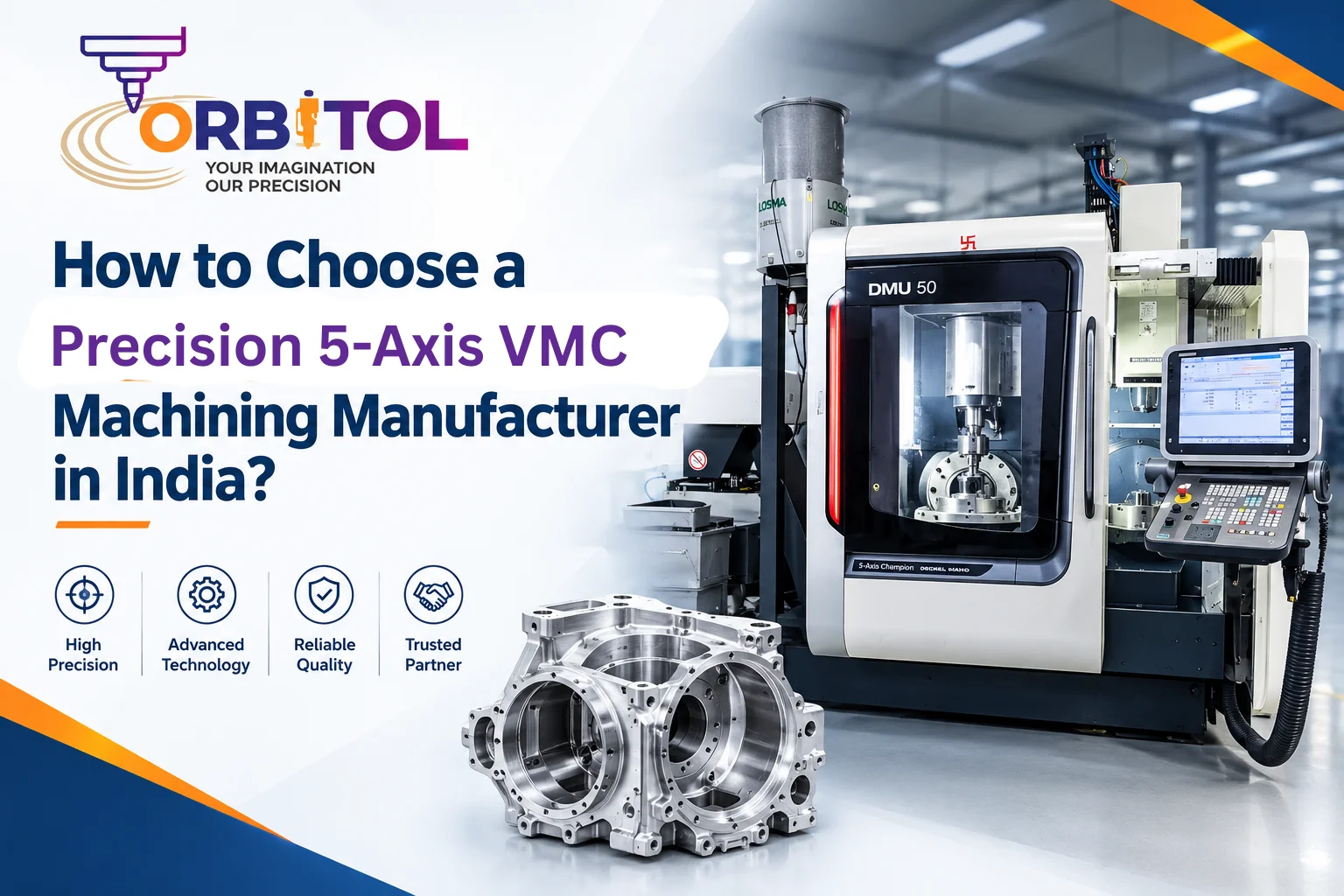
Precision 5 Axis VMC Machining , When you need a machine component that fits perfectly and works reliably. Choosing the right manufacturer becomes a big decision. A small dimensional error can affect the performance of an entire assembly, leading to rework, delays, and additional costs. This is one reason many industries rely on Precision 5 Axis VMC Machining to produce complex parts with accurate dimensions and a consistent finish.
From automotive components to aerospace parts and industrial machinery, manufacturers often deal. With designs that are difficult to machine using conventional methods. Five-axis technology makes these jobs easier by allowing access to multiple surfaces with fewer setups. However, getting good results depends on more than having an advanced machine
That’s especially true for Precision 5 Axis VMC Machining. This is not routine work. The parts are usually intricate, the tolerances are tight, and the machines, programming and inspection behind them take serious investment and experience. A wrong choice doesn’t just cost you money. It can delay your whole product launch.
In this guide, we’ll go through what actually matters. When evaluating a 5 Axis VMC Machining Manufacturer in India: the equipment, the people, the quality systems and the questions worth asking before you place an order.
Table of Contents
- Why Precision 5 Axis VMC Machining Is Worth the Investment
- Why Manufacturers Choose 5 Axis VMC Machining in India
- Machines, Programming and Engineering Expertise
- Quality Control, Certifications and Material Knowledge
- Why Orbital Intelligence Is Worth Considering
- Conclusion
1. Why Precision 5 Axis VMC Machining Is Worth the Investment
Standard 3-axis machines only allow for movement along the X, Y, and Z axis. A 5-axis machine. On the other hand, has two rotary axes which means that the cutting tool. Can tilt and rotate in any direction while machining. The implication of this is that the tool doesn’t have to be unclamped and re-positioned to reach the workpiece from any angle.
This is important for several reasons. First of all, fewer setups mean that there are fewer chances for errors to occur. Moving a part to different fixtures comes with the danger that the reference point may shift a bit every time the part is being moved. Secondly, 5 axis machining is capable of producing complicated designs like compound angles, entrances, and other such shapes; all of which would be impossible on simpler machines. Finally, a 5-axis machine gives better cutting angle.
When this is done on a vertical machining center, you get the flexibility of VMC Machining combined with the reach of five axes. It’s a strong combination for aerospace, medical, defense, automotive and industrial parts. But the machine alone doesn’t guarantee results. It takes skilled programmers, proper fixturing and disciplined inspection to turn that capability into good parts.
2. Why Manufacturers Choose Precision 5 Axis VMC Machining in India
India’s manufacturing base has grown a lot in the past decade. Many shops have moved well beyond basic job work and now run advanced multi-axis equipment, work to international drawings, and supply customers in aerospace, medical devices, defense and electronics.
A few reasons buyers, both domestic and overseas, look at 5 Axis VMC Machining in India:
Cost advantage. Labor and overhead costs are lower than in many Western countries, enabling competitive pricing at no loss of capabilities.
There is a large supply of skilled engineers in India, including a significant number of mechanical engineers and trained operators and programmers of VMC machines.
There is a growing supply chain ecosystem, as many suppliers of materials, tools, heat treatment, and surface treatment services are located in close proximity to the main machining hubs, thus reducing the time needed for delivery.
Many Indian companies carry out the export of products and, thus, are familiar with the requirements for documentation, packaging, and shipping.
3. Machines, Programming and Engineering Expertise
Machine capability and condition
Let’s first discuss the machines. Inquire about the 5-axis systems that the facility uses in terms of their model, make and capability. There’s a difference between these 2 machine types. True 5-axis enables all the axes to move at once while machining – this is critical for shapes where contours are complicated. The other machine has the rotary axes locked and engages in machining after the axles have been secured.
Also, ask about the age of the machine as well as its maintenance. Good machines that have not been properly serviced and maintained do not perform well when it comes to precision. Regular calibration and checks of the spindle along with proper maintenance practices is a sign of the good machines.
Programming and engineering support
5-axis machines depend on the software (CAM) used to operate them. A badly written program could cause problems such as tool collision or gouged surfaces. Find out if they write the programs themselves, what software they use, and whether they simulate the program before cutting anything.
Any reputable manufacturer is one that gives design-for-manufacturing feedback. If they suggest changes such as the size of a radius or the thickness of a wall that makes it easier for them to make your part, then they have experience.
Tolerance capability
Don’t let them tell you about their general capabilities like “we do precision work.” Ask them about the tolerances they achieve in everyday operations. For precision machined parts, you will need specific numbers from them and see how they check to make sure that they are achieved. Request some samples.
4. Quality Control, Certifications and Material Knowledge
Inspection and quality systems
This is where many buyers get caught. A shop may have the ability to manufacture precise components, but that doesn’t help if they can’t demonstrate it.
Check if the shop has the right equipment for inspection including coordinate measuring machines (CMM), measuring gauges, surface finish measuring tools and an appropriate inspection room. Find out if they give inspection reports, material test reports, and the initial article inspection (FAI) paperwork with shipments. For some industries it is expected that the shop has certificates like ISO9001 or AS9100 for aviation production.
Material knowledge
Different materials behave differently while being machined. Aluminum is machined fast and clean. Stainless steel gets hardened while being machined, while titanium is hot and wears out tools fast. Inconel is tough to work with. An experienced manufacturer who is skilled in working with the material in question will be aware of the different speeds and feeds.
Be aware of the types of materials that are used in the process and the sources of the materials used.
The safety of proprietary information and intellectual property. If the design is proprietary, ask if they are willing to sign a non-disclosure agreement and how they regulate access to various documents and files.
5. Why Orbital Intelligence Is Worth Considering
While compiling a list of options, you may also want to consider Orbital Intelligence. This company specializes in precision 5-axis VMC machining with a focus on producing precision machined parts where the quality of processing is critical.
What customers expect from a partner is what serious manufacturers must deliver: a proper assessment of your design prior to starting work, truthful open-ended responses and feedback on what can be done, thorough inspection and paperwork, and assistance from prototyping to mass-production of the order. If there’s a component requiring 5-axis machining but you don’t know how to accomplish it, just show your drawing to Orbital Intelligence and begin the dialogue regarding tolerances and specifications before making any commitments.
6. Conclusion
Choosing a 5 Axis VMC Machining in India is not simply a question of finding the lowest price. The correct company is the one which combines hi-tech equipment, well-trained programmers, good quality inspections, a high level of knowledge regarding the materials used, and honesty in communication. With one of these elements missing, you are likely to end up with faulty pieces, delays, or need time-consuming rewrites.
Do not hesitate to ask direct questions, see the samples produced by the company, and check the company’s certifications and ability to inspect the item being manufactured. To minimize the risk, it is advisable to start your cooperation with the manufacturer with a small test order and evaluate how it is being dealt with from the first e-mail to the receipt of the item.
Looking for more manufacturing insights? Explore Orbitol Intelligence for useful information to help you make informed decisions about precision machining and industrial engineering.