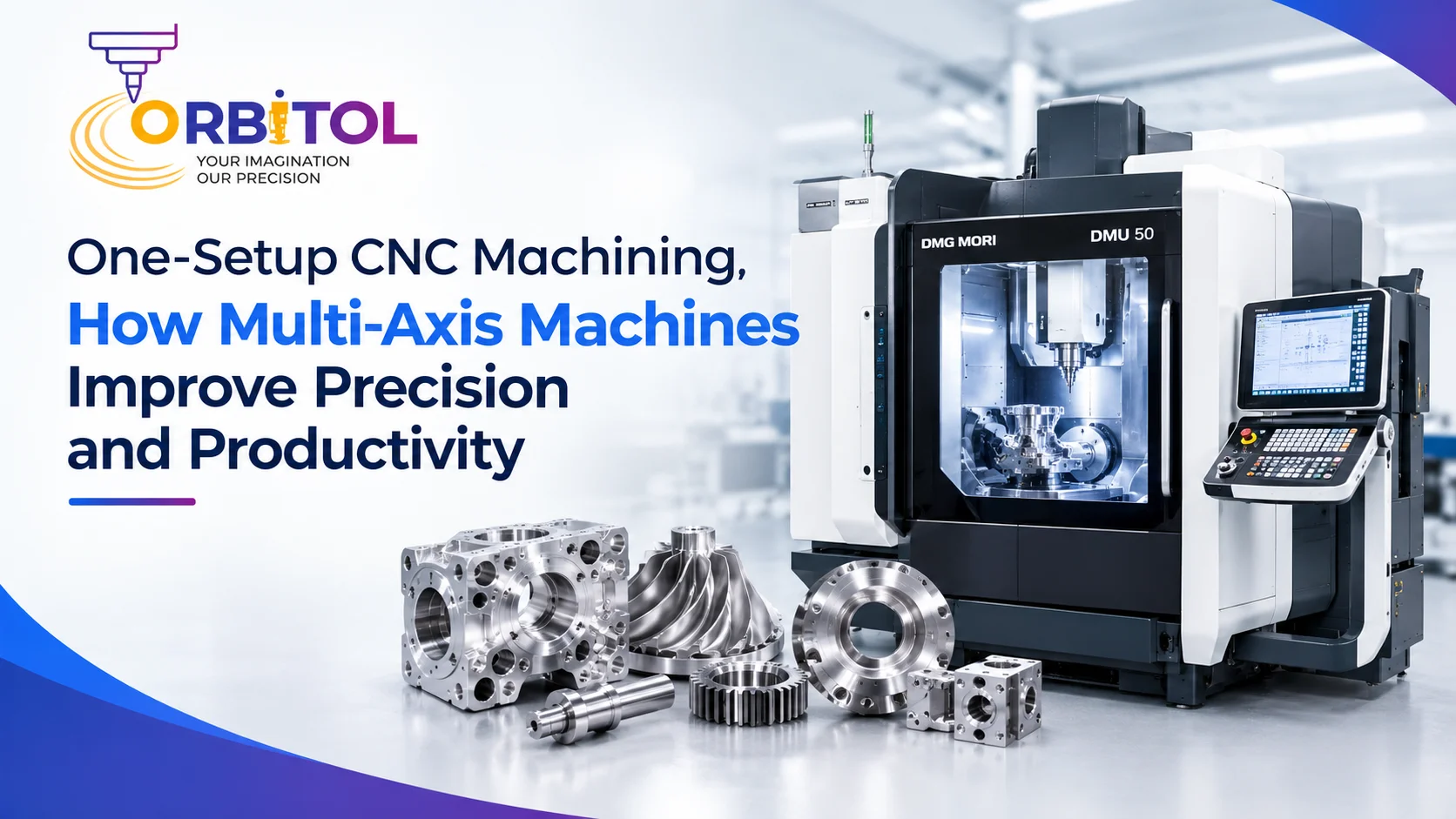
Multi Axis Machining, If you enter a serious production facility these days. You are sure to find something interesting more than just cutting metal, modern machines are doing. That while holding the object in a steady position from 5 Axis, 3 Axis, sides at once. This idea is called Multi Axis Machining. Which is probably the most important advance in manufacturing.
For decades, shops leaned on 3-axis machines. They worked fine, but they had a built-in weakness every time a part needed a feature on a different face. Someone had to stop, unclamp it, flip it, re-align it, and start again. Do that three or four times on one part, and you’ve opened the door to three or four different chances for something to go slightly off. Multi-axis CNC Machining gets rid of most of that back-and-forth. The part goes in once, the machine works around it from multiple angles, and it comes out finished Often without a human hand touching it in between.
In this post, we’ll get into how Multi Axis Machining actually works. Why it beats the old multi-setup approach, and where it’s making the biggest difference especially in industries. That live and die by High Precision Machining and Tight Tolerance Machining. We’ll also talk about how a manufacturing partner like Orbitol Intelligence is helping companies put one-setup machining to work in real production runs, not just in theory.
Table of Content
- What Is Multi Axis Machining?
- How Multi-axis CNC Machining Improves Precision
- One-Setup Machining and CNC Machining Productivity
- 5 Axis VMC Machining: The Next Level of Complexity
- Where High-Quality CNC Machined Parts Are Used
- Why Orbitol Intelligence Is the Right Manufacturing Partner
1. What Is Multi Axis Machining?
At its simplest, Multi Axis Machining is a CNC process. Where the cutting tool and the part move along more than three axes at the same time usually four or five, though some setups go beyond that. A standard 5Axis, 3-axis machine only travels along X, Y, and Z. Add rotational axis (engineers call them A, B, or C) and suddenly the tool can swing around and reach angles that used to require pulling the part out and starting over.
That one addition rotation is really what makes Multi-axis CNC Machining so useful. Curved surfaces, deep pockets, awkward angled features. These used to mean multiple operations and multiple fixtures. Now, because the spindle or the table itself can tilt and rotate. The machine reaches around the part instead of asking the part to move to it.
Here’s the part that matters most for quality: every time you unclamp and reposition a work piece you introduce a small amount of error. It might be tiny a few microns but in fields where tolerances are measured in microns to begin with, tiny is enough to fail an inspection. Multi Axis Machining sidesteps that problem almost entirely by keeping the part locked in one position while the tool does all the moving.
2. How Multi-axis CNC Machining Improves Precision
If there’s one thing shops care about more than speed it is precision and this is where Multi-axis CNC Machining really earns its reputation. Keep a part clamped in a single fixture from start to finish, and you eliminate the accumulated drift that comes from multiple setups. That is essentially what High Precision Machining comes down to. Every cut, hole, and contour referenced from the exact same starting point.
A few specific things happen when your machine this way
- The tool can reach several surfaces of a part without the part itself ever moving. So the geometric relationships between features stay exactly as designed.
- Fewer setups mean fewer chances for a clamp to shift even slightly. Which is exactly what Tight Tolerance Machining depends on.
- Tool paths flow more continuously across curved and angled surfaces. Which tends to leave a cleaner, more consistent surface finish.
- Because a program controls every axis in real time. One part in a batch of five hundred looks almost identical to the last.
This matters enormously in fields like aerospace, medical devices, and precision instrumentation. Where a single misaligned setup can turn an expensive part into scrap. Modern multi-axis machines also come equipped with in-cycle probing the machine essentially checks its own work mid-process and nudges itself if something’s drifting, long before a tolerance issue turns into a defect. Pair that with rigid machine frames and temperature-stable shop floors, and you get the kind of consistency that older 3-axis setups simply couldn’t guarantee.
3. One-Setup Machining and CNC Machining Productivity
Precision gets most of the attention, but the productivity gains from Multi Axis Machining are just as significant. Maybe more so, if you’re the one paying for shop time. One-setup machining means a part goes into the machine once and comes out done. No repositioning halfway through, no queue waiting for a second operation, no dead time between steps.
Picture a bracket that needs machining on five different faces. On an older 3-axis machine, that could mean three, four, even five separate setups each one needing its own fixture check and alignment pass. On a multi-axis machine, that same bracket often comes off in a single cycle. The savings show up everywhere:
- Cycle times shrink because the spindle is actually cutting instead of sitting idle between setups.
- Operators spend less time loading, unloading, and re-clamping. Which lowers labor costs across a shift.
- Parts move through the shop faster since they’re not sitting in a queue waiting on the next operation.
- Fewer manual transfers mean fewer chances of dropping, scratching, or misplacing a part.
- Lead times shrink too prototype work that once took weeks can sometimes wrap up in days.
None of this is theoretical. Shops that switch from a multi-setup 3-axis workflow to Multi-axis CNC Machining. Routinely see real drops in total production time per part, along with fewer scrapped pieces. Add modern CAM software that simulates the entire tool path catching collisions before the program ever touches real material and you get a process that’s both faster and safer to run.
4. 5 Axis VMC Machining, The Next Level of Complexity
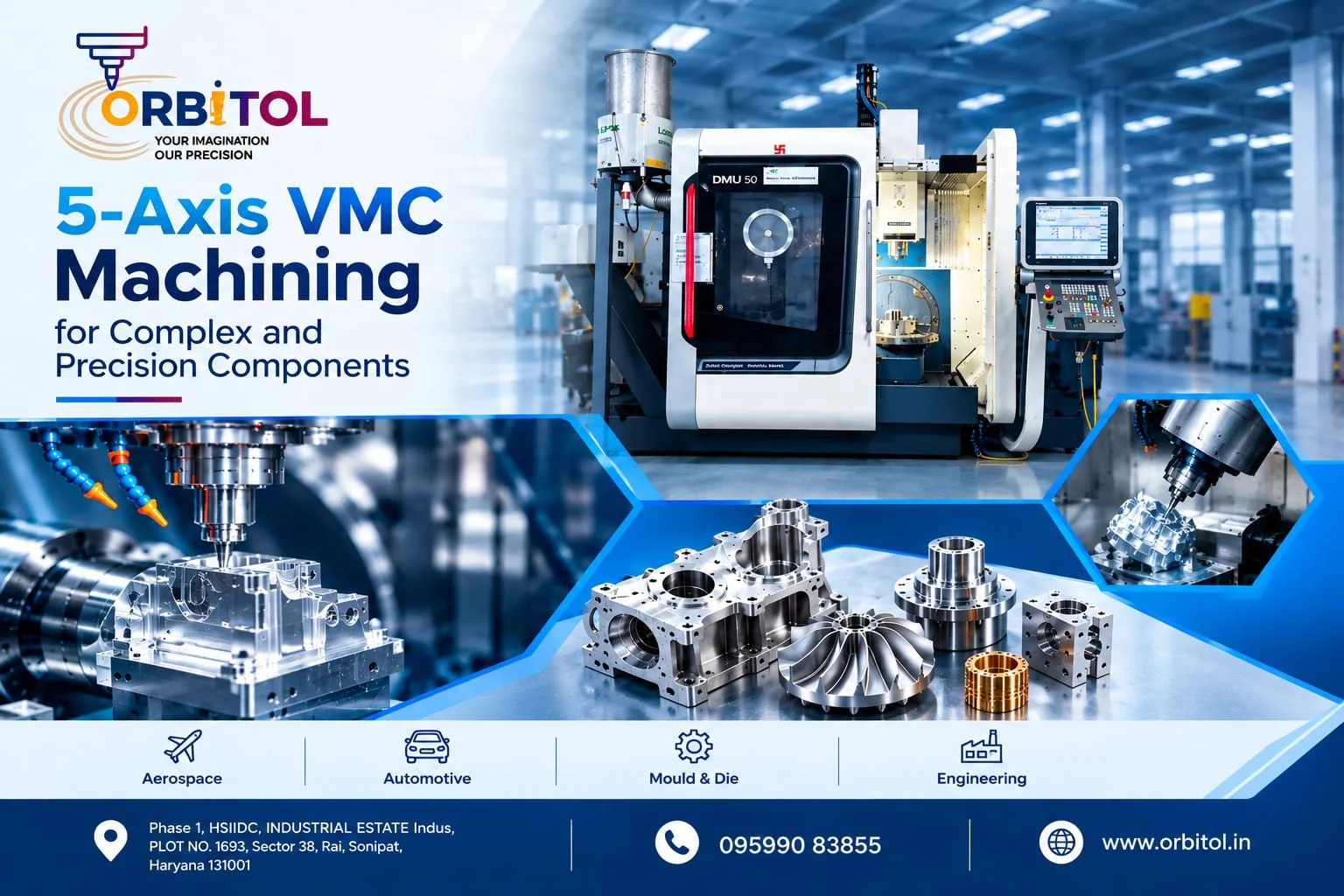
Within the broader world of Multi Axis Machining, 5 Axis VMC Machining is the version most associated with truly complicated parts. A 5-axis machine keeps the standard X, Y, Z movement but adds two rotational axes on top, giving the cutting tool near-total freedom to come at a part from almost any direction you can imagine.
There are generally two ways this plays out
3+2 (positional) machining: The machine will set the part in the desired place and secure it and then perform the cuts as if using conventional 3-axis machining. This technique is easy to program and works well for the job where there are several angled features. So that there is no necessity to work in a defined motion for the whole process.
5-axis simultaneous machining, Here all five axes move together making it possible to maintain the required angle of cutting for any complex contour. This is the method behind the most intricate shapes think turbine blades, impellers, and other organic, flowing surfaces.
5 Axis VMC Machining really shows its value on parts with undercuts. Compound angles, and deep cavities geometries that are close to impossible with fewer axes. It also allows shorter, more rigid tool engagement, which helps Tight Tolerance Machining by cutting down on vibration and tool deflection mid-cut.
It’s no surprise, then, that aerospace, defense, motorsport, and medical implant manufacturers lean so heavily on 5 Axis VMC Machining. In these industries, High Precision Machining and complex geometry aren’t nice-to-haves they are the baseline.
5. Where High-Quality CNC Machined Parts Are Used
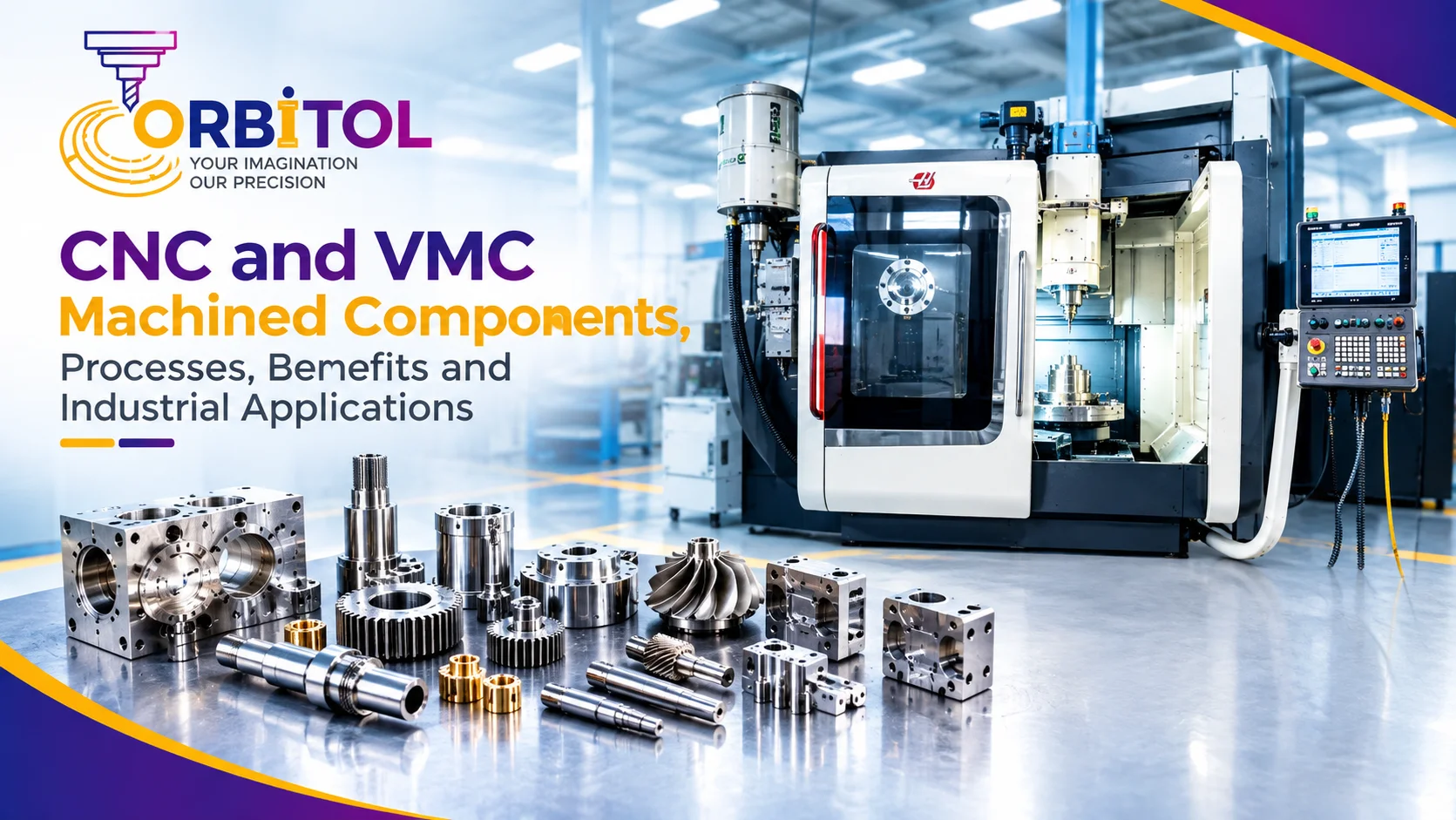
Demand for well-made CNC Machined Parts stretches across nearly every corner of advanced manufacturing. A few of the biggest examples
- Aerospace components – structural brackets, housings, and turbine parts that have to meet strict certification standards built around High Precision Machining.
- Medical devices – surgical instruments and implants where Tight Tolerance Machining isn’t optional, because patient safety rides on exact dimensions.
- Automotive and motorsport parts – engine components and lightweight structural pieces that lean on the strength and accuracy Multi-axis CNC Machining provides.
- Industrial equipment – custom gearboxes, valve bodies, and hydraulic manifolds packed with complex internal geometry.
- Electronics and robotics – precision enclosures and mounts where dimensional consistency directly affects how well the final assembly fits together.
Across every one of these industries, one-setup Multi Axis Machining cuts down the number of places something could go wrong, while speeding up how quickly parts move through production. As designs get more geometrically ambitious and tolerances get tighter, multi-axis capability is turning from a nice edge to have into something you simply can’t compete without.
6. Why Orbitol Intelligence Is the Right Manufacturing Partner
The machine matters, but who is running it matters just as much. That is where Orbitol Intelligence comes in. The team pairs advanced 5 Axis VMC Machining capability with tight quality control, so every batch of CNC Machined Parts actually meets the spec you handed over not a close approximation of it.
A few reasons manufacturers turn to Orbitol Intelligence for High Precision Machining and Tight Tolerance Machining work
Real, hands-on experience programming complex, simultaneous multi-axis tool paths for parts that aren’t simple.
In-process probing and inspection built into the workflow, catching deviations before they ever become defects.
A genuine focus on one-setup machining strategies that push CNC Machining Productivity up and shorten delivery times.
A team that stays involved from initial design through final inspection, so the part you get back is the part you actually asked for.
Whether it’s a single complicated prototype or a full production run, Orbitol Intelligence applies Multi-axis CNC Machining the right way accurate, consistent, and on schedule.
Final Thoughts
Multi Axis Machining has changed what’s realistically possible on a shop floor. Pair Multi-axis CNC Machining with a one-setup approach, and you get levels of High Precision Machining and Tight Tolerance Machining that older methods just could not touch all while pushing CNC Machining Productivity higher and shrinking lead times. Whether it’s 5 Axis VMC Machining tackling the most intricate geometries or reliable, repeatable output on high-volume CNC Machined Parts, the payoff shows up at every stage of production.
If your next project needs precision, speed, and a manufacturing partner who actually understands both, Orbitol Intelligence is ready to turn a complicated design into a finished, flawlessly machined part in one setup, done right the first time.