Introduction
Some parts simply refuse to cooperate with a machine that only moves in three directions. A turbine housing with angled ports, a medical implant with contoured surfaces, a mold core with deep, curved cavities try producing any of these on a standard three-axis setup and you’ll spend more time flipping, re-clamping, and re-aligning the part than you will actually cutting it. That’s the exact problem 5-Axis VMC Machining was built to solve.
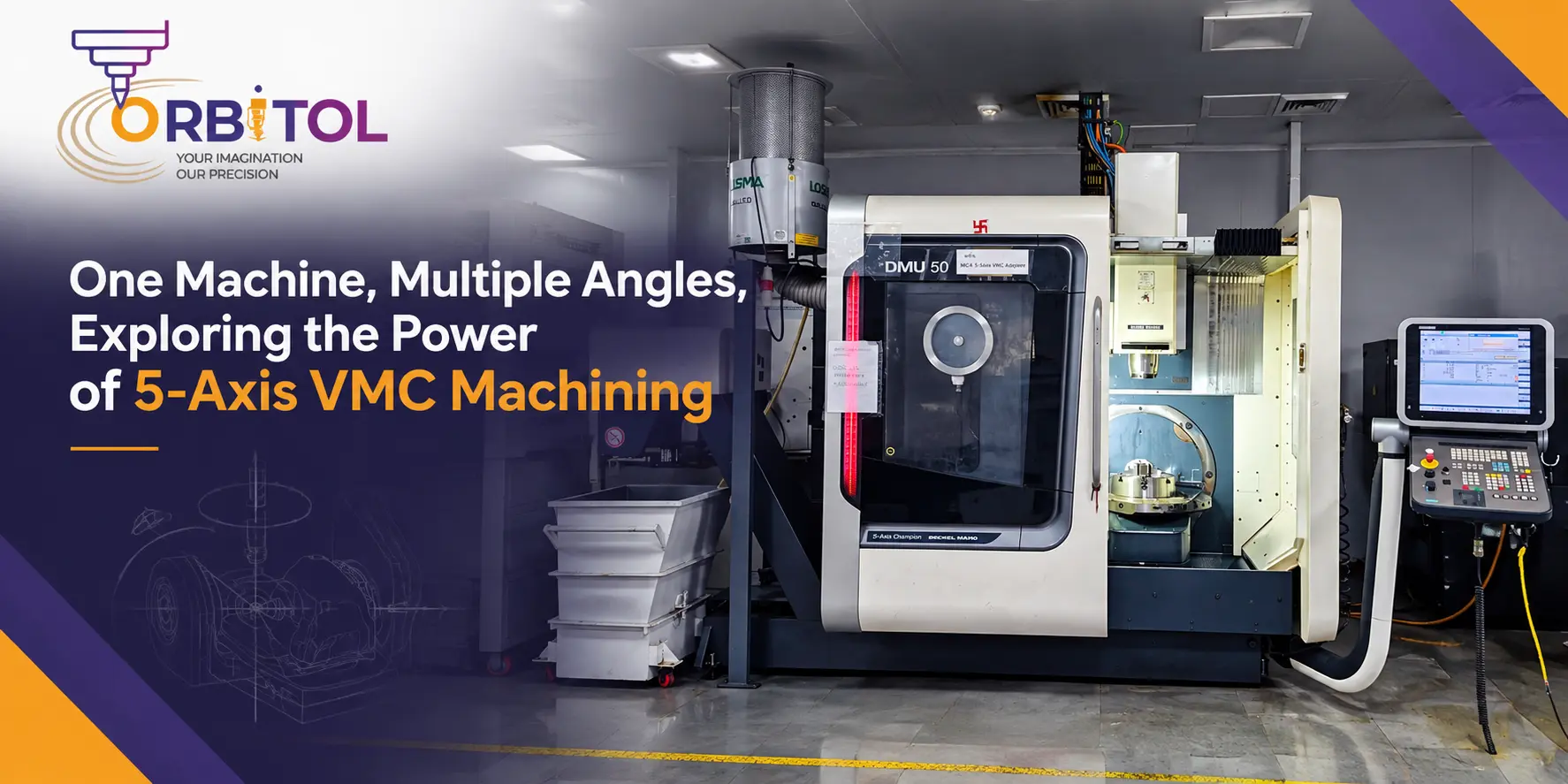
By adding two rotational axes to the standard vertical machining setup, a vertical machining center can approach a workpiece from nearly any direction without ever unclamping it. One setup, multiple angles, and a level of accuracy that’s genuinely difficult to replicate any other way. For manufacturers producing complex, high-tolerance parts, this single capability — the core of every 5-Axis VMC Machining process — changes what’s actually possible on the shop floor.
This guide breaks down what 5-Axis VMC Machining actually is, how it differs from standard vertical machining, what makes 5 axis vertical machining centers so valuable across industries, and what to look for when choosing 5-Axis VMC Machining Services for your next project.
What Is 5-Axis VMC Machining?
A vertical machining center, or VMC, is a CNC machine where the spindle sits vertically, cutting straight down into the workpiece — the setup most people picture when they think of a milling machine. A standard VMC moves along three linear axes: X, Y, and Z.
5-Axis VMC Machining adds two more axes to that foundation, typically rotational movement around two of the three linear axes. Instead of only moving up, down, and side to side, the table or the spindle head can now tilt and rotate as well. That means the cutting tool can reach a workpiece from virtually any angle, without the operator having to stop the job, unclamp the part, and reposition it for the next cut.
This is where five axis vertical machining centers really separate themselves from conventional equipment. A three-axis VMC might need three, four, or even five separate setups to machine every face of a complex part. A multi-axis VMC machine can often complete the same job in a single setup, machining multiple faces and angled features without ever breaking the part’s original alignment — the defining advantage over conventional milling.
How the VMC Machining Process Actually Works
The VMC machining process starts the same way most CNC work does — with a CAD model defining the part’s geometry, dimensions, and tolerances. From there, CAM software converts that model into toolpaths, this step is considerably more involved than programming a standard three-axis job.
The programmer has to account for tool orientation at every point in the cut, how the rotational and linear axes will move together, where collisions might occur between the tool, the fixture, and the part itself, and what cutting parameters make sense for the material being machined. Simulation software plays a bigger role here too, since a mistake in a 5-axis toolpath can be far more costly than one on a simpler three-axis job.
Once programming is finalized, the raw material gets fixtured onto the machine table. Workholding matters just as much here as the programming does — if the part shifts even slightly during a multi-angle cut, the entire job can be ruined. From there, the multi-axis VMC machine runs the program, coordinating linear and rotational movement simultaneously to keep the cutting tool oriented correctly as it works its way across every angled surface, undercut, and contoured feature on the part.
After machining, the finished part goes through inspection — dimensional checks, surface finish verification, and in many industries, full documentation tying the part back to its exact production parameters. This final inspection stage is what actually confirms high accuracy machining was achieved, rather than simply assumed.
3+2 Machining vs Simultaneous 5-Axis Machining
It is not necessary for every job that requires 5-axis VMC machining to make use of all 5 axes of movement. Depending on the design of the part, manufacturers typically pick between two methods.
3+2 machining locks the two rotational axes into a fixed position first, then completes the cut using only the three linear axes from there. It’s a more straightforward way to program complex parts on five axis VMC and it still gives access to angled surfaces a standard three-axis machine simply couldn’t reach without a separate setup. When you are working on parts with a limited number of different angled surfaces, rather than continuously flowing contours, this method works well due to its simplicity and efficiency.
When working with simultaneous 5-axis machining, all five axes will move together continuously through the process of cutting. The tool will change its orientation in real-time as it follows the shape of the surface. Hence, this process is best suited for impellers, turbine blades, complicated molds, and other parts with freeform geometry. It also demands more from everything involved a capable CNC controller, sophisticated CAM programming, the right tooling, and thorough collision simulation before the job ever touches the machine.
Why 5 Axis Vertical Machining Centers Matter So Much
The core advantage here comes down to accessibility. A standard vertical machining center can only reach a part from a limited number of fixed directions, which means complex geometry usually requires multiple setups — and every time a part comes off the machine and goes back on, there’s a real chance something shifts out of alignment.
With a multi-axis VMC machine, the tool can tilt and rotate to reach surfaces that would otherwise need a completely separate operation. Fewer setups generally mean tighter alignment between features, less handling overall, and a process that’s considerably easier to keep consistent from one part to the next — especially valuable for parts where multiple surfaces have to maintain a precise positional relationship with each other. This is the practical value 5 axis vertical machining centers bring to any shop producing genuinely complex work.
Key Benefits of 5-Axis VMC Machining
Fewer setups, less handling. Parts that would need several separate fixturing operations on a standard VMC often get completed in one or two setups on a 5-axis vertical machining center, cutting down on setup time and the risk of misalignment between operations.
Access to genuinely complex geometry. Tilting and rotating the tool opens up angles, undercuts, and contoured surfaces that would otherwise require special fixtures or additional machining operations to reach at all.
High accuracy machining as standard, not an exception. Keeping the tool oriented correctly throughout a cut tends to produce cleaner, more even results on curved and contoured surfaces, and the reduced handling means high accuracy machining becomes far more repeatable across an entire production run.
Tighter positional accuracy between features. Less repositioning means the relationships between holes, faces, and other critical features are far easier to hold to tight tolerances.
Fewer downstream operations. A well-planned VMC machining process can often eliminate secondary operations that would otherwise be needed later in the production process.
Shorter overall cycle times. Even though programming a 5-Axis VMC Machining job takes more upfront work, the reduction in setups and repositioning frequently makes the total production time shorter than running the same part through multiple 3-axis operations.
Applications Across Industries
The versatility of 5-Axis VMC Machining has made it valuable across a wide range of manufacturing sectors:
Aerospace — structural brackets, housings, and complex components where weight, tolerance, and geometry all matter simultaneously, typically produced through dedicated 5-Axis VMC Machining Services.
Medical devices — implants and surgical instruments with contoured surfaces and tight dimensional requirements that leave no room for error.
Automotive — prototypes, complex housings, tooling, and performance components requiring precise multi-angle machining.
Mold and die making — contoured cavities and cooling channels that benefit enormously from a tool that can approach at the correct angle rather than being limited to a fixed direction.
Energy and turbine manufacturing — impellers, blades, and housings with freeform surfaces that are genuinely difficult to produce any other way.
Industrial equipment — custom housings, fixtures, and mechanical components built around specific operational requirements.
Each of these industries relies on 5 axis vertical machining centers precisely because the parts involved simply can’t be produced reliably any other way.
Materials Commonly Machined on 5-Axis VMC Equipment
The right material depends on the part’s mechanical requirements, operating environment, and weight targets, but a handful of materials show up consistently in five axis VMC Machining work:
Aluminum — lightweight and relatively easy to machine, a common default for precision components across industries.
Stainless steel — chosen for strength and corrosion resistance, with machining parameters that vary depending on the grade.
Titanium — an excellent strength-to-weight ratio, though it demands careful control over cutting conditions and tooling.
Alloy steel — used where wear resistance and durability take priority over weight.
Engineering plastics – beneficial when one needs to get chemical resistance, electrical insulation, or lighter weight as opposed to strength.
Different materials behave differently under the VMC machining process, hence experienced shops are able to set feeds, speeds and cooling methods accurately for every job instead of applying generic numbers to each project.
Choosing the Right 5-Axis VMC Machining Services
A few things are worth confirming before committing to a provider of 5-Axis VMC Machining Services:
Machine capability — make sure the provider has the right multi-axis VMC machine configuration and capacity for your specific part, not just somewhere on the shop floor.
Engineering expertise — a strong partner understands CAD/CAM programming, toolpath strategy, fixture design, and collision simulation, not just how to run the equipment.
Material experience — ask directly whether they’ve worked with your specific material before, especially for anything more demanding like titanium or high-nickel alloys.
Quality inspection capability — confirm what measurement equipment they have on hand and how they verify dimensional accuracy once a part comes off the machine, since this is what actually proves high accuracy machining was delivered.
Scalability — make sure they can support your project from prototyping through full production volume, without needing to change 5-Axis VMC Machining Services providers mid-program.
The Future of 5-Axis VMC Machining
As manufacturing continues to push toward tighter tolerances and more complex part geometry, 5-Axis VMC Machining is only becoming more central to how precision components get made. Advances in CAM software are making programming faster and more intuitive, while improved collision simulation is reducing the risk involved in running genuinely complex toolpaths.
At the same time, growing demand for lightweight, high-performance parts across aerospace, medical, and energy sectors is pushing 5 axis vertical machining centers toward even greater precision and adaptability. As industries continue to design parts with increasingly intricate geometry, the manufacturers who’ve invested in a capable multi-axis VMC machine and refined their VMC machining process will be the ones best positioned to produce them.
Conclusion
5-Axis VMC Machining isn’t just an upgrade over standard three-axis milling it’s a fundamentally different way of approaching complex part production. Incorporating a vertical machining center along with two added rotational axes permits manufacturers to work on various angles, shapes, and recesses that would otherwise need several distinct processes while allowing better accuracy and limited chances of misalignment between processes.
Regardless of whether the process is used for aerospace brackets, medical devices, turbine parts, or other patterns such as molds vertical machining centers allow manufacturers to make geometrically complex shapes while maintaining proper precision. For companies working with complex parts, partnering with a provider of proven 5-Axis VMC Machining Services is often the difference between a part that’s technically possible and one that’s actually practical to produce.