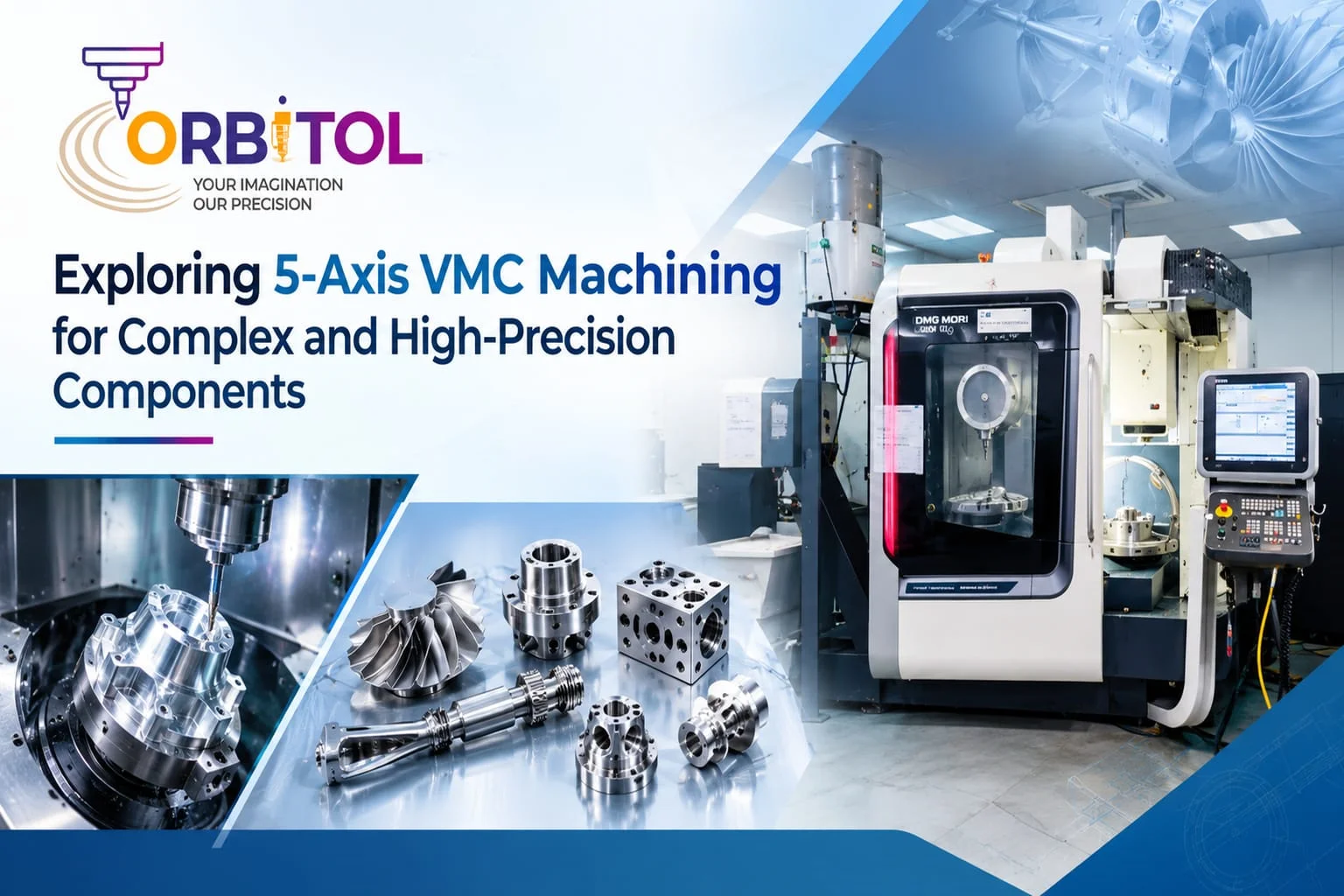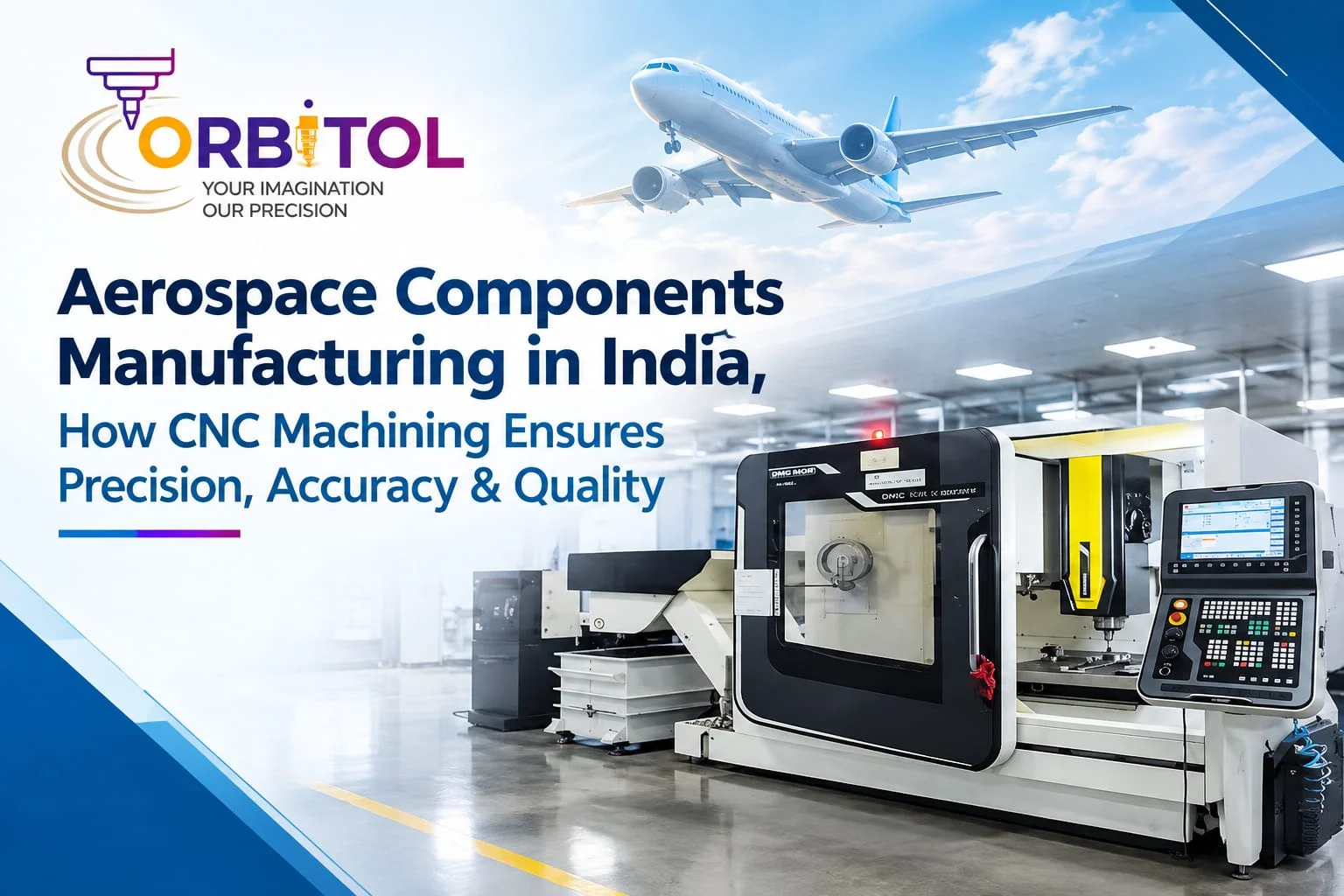
VMC Machining, Modern VMC technology is particularly useful. When manufacturers need to produce complex components while maintaining consistent results from the first component to the last.
Orbitol Intelligence, precision manufacturing capabilities include 3-axis and 5-axis CNC/VMC machining. Swiss-type machining and complementary inspection and manufacturing processes. The company lists aerospace and defense among its key industries.
Table of Contents
- Introduction to VMC Machining for Aerospace and Defense
- Why Precision Matters in Aerospace and Defense Components
- How VMC Machining Improves Component Accuracy
- Role of 5-Axis VMC in Complex Aerospace Parts
- Applications of VMC Machined Components
- Materials Used in Aerospace and Defense Machining
- How Orbitol Intelligence Supports High-Precision Manufacturing
- Quality Control in Aerospace Component Manufacturing
- Conclusion
1. Introduction to VMC Machining for Aerospace and Defense
Aerospace and defense components are not ordinary engineering parts. These components often have intricate shapes, strict size tolerance limits, and critical surfaces and materials that require accurate processing. A slight dimensional change could influence. How a part performs, fits, or moves together with other components.
This is exactly where Vertical Machining for Manufacturing comes in handy.
The Vertical Machining Centers are machines operated electronically capable of performing various operations. Such as milling, drilling, tapping, pocketing, and contouring. When powerful enough, and provided. With suitable tooling, CAD or CAM. As well as work and inspection means. VMC machines can make various products following strict engineering specifications.
In manufacturers that design aerospace equipment, it is important not only to take away steel. The process must maintain dimensional accuracy, surface quality, feature location and repeatability throughout production.
2. Why Precision Matters in Aerospace and Defense Components
Aerospace and defense systems operate under demanding conditions. Components may experience vibration, mechanical loads, temperature changes and repeated movement. Because individual parts work together as assemblies, dimensional consistency becomes extremely important.
A part that falls outside its required tolerance can create problems during assembly. As a result, it may also affect the functionality of other components.
That is why High Precision Machining is important for sectors. Where absolute precision and consistency are crucial.
Typical requirements can include
- Tight dimensional tolerances
- Accurate hole locations
- Controlled surface finish
- Complex contours
- Precise angular features
- Consistent component-to-component dimensions
- Reliable inspection and documentation
For example, aerospace tooling, brackets, fixtures, housings, structural parts, pins and other precision components. May require different machining strategies depending on their geometry.
The correct machining approach begins with understanding the component. Drawing, material, tolerance requirements and critical features.
A modern Vertical Machining Center. Can then be programmed to follow the required tool paths accurately. For more complicated components, multi-axis machining. Can provide access to surfaces that are difficult to reach using conventional machining methods.
Orbitol Intelligence states that its precision manufacturing setup. Can achieve tolerances down to ±5 microns for suitable applications. Supported by advanced machining and quality-control processes.
3. How VMC Machining Improves Component Accuracy
One of the key benefits of VMC Machining is the fact. That there is controlled and repeatable movement of a tool.
Instead of depending on manual positioning, the machine follows instructions fed into it using CAD/CAM software. This permits engineers to control feeds, the speed of spindle and the order. Which machining operations are done, based on demands of the part.
The process usually consists of several important steps
Design and Programming
The process begins with a 3D model or an engineering drawing. Next, the programmer reviews the geometry and selects the required machining operations. Finally, the CNC machine executes the programmed operations with precision.
Machining
The CNC programmer enters the required instructions, and the machine executes each operation. That were fed into it previously. Some of the operations performed include roughing. Semi-finishing, finishing, drilling etc.
CAM software is then used to generate appropriate tool paths.
Work holding and Setup
Operators must position the component securely and accurately. A stable setup helps maintain dimensional relationships between different features.
For complex components, reducing the number of setups can also reduce repositioning errors. Consequently, manufacturers can maintain better dimensional consistency.
Tool Selection
Different materials and features require suitable cutting tools. Tool geometry, diameter, coating and cutting conditions can influence tool life, surface finish and dimensional accuracy.
Controlled Machining
The equipment carries out the programmed tasks. Depending on the part, these may include rough machining. Semi-finishing, finishing, boring, tapping and contour processing.
Inspection
Once finishing is done, it is possible to measure the main dimensions and characteristics of the manufactured part for compliance with design specifications.
This complete approach is what makes modern High Precision Machining. More than simply operating a CNC machine. Machine capability, programming, tooling, setup and inspection all contribute to the final result.
4. Role of 5-Axis VMC in Complex Aerospace Parts
Some aerospace and defense components. Have compound angles, curved surfaces, undercuts and features located on multiple sides of the component.
Machining these features using only conventional 3-axis operations can require multiple setups.
A 5-axis Vertical Machining Center can provide additional movement and tool orientation. Allowing the cutting tool to approach complex features from different directions.
The benefits can include
- Better access to complex surfaces
- Reduced number of setups
- Improved relationship between machined features
- Better machining flexibility
- Efficient production of complex geometries
- Reduced repositioning requirements
Orbitol Intelligence uses the DMG MORI DMU 50 for 5-axis machining. The machine is listed with capabilities including complex profiles, compound angles, undercuts, freeform surfaces and one-setup machining.
For suitable aerospace applications, this type of capability can be useful. When several critical features need to be produced. While maintaining their positional relationship.
However, machining these features using conventional 3-axis operations can require multiple setups.
This process-based approach is important because VMC Machined Components. Should be manufactured using the machining strategy. That best matches their actual engineering requirements.
5. Applications of VMC Machined Components
Modern VMC Machined Components can be found across several aerospace and defense applications. The exact machining process depends on the component’s geometry and functional requirements.
Aerospace Tooling
Tooling used in aerospace manufacturing often requires accurate surfaces and repeatable dimensions. VMC technology can support the production of tooling components. Fixtures and other precision manufacturing aids.
Jigs and Fixtures
Jigs and fixtures help position and hold components during manufacturing or assembly. Their accuracy directly influences the positioning of the part being processed.
Precision VMC machining can produce mounting surfaces. Locating features, holes and other critical geometries.
Structural Components
Aerospace structures can include components with pockets, holes, angled surfaces and lightweighting features. Manufacturers use CNC milling to create these geometries from suitable engineering materials.
Engine-Related Components
Certain engine and propulsion-related components can contain complicated profiles and critical surfaces. Depending on the design. Multi-axis machining may be used to achieve the required geometry.
Aerospace Pins and Small Components
Not every aerospace component is large or complex. Small pins, shafts and cylindrical components. Can also require tight dimensional control.
For such components, other machining technologies. Such as Swiss-type machining may be more appropriate than a VMC. Orbitol manufacturing ecosystem includes. Swiss-type machines alongside its VMC capabilities.
Defense Components
Defense manufacturing can involve precision housings, brackets, fixtures, tooling and other mission-critical components. The machining strategy depends on the component. Design, material and tolerance requirements.
This is one reason why a versatile High Precision Machining Company needs more than one type of machining technology.
6. Materials Used in Aerospace and Defense Machining
Material selection plays an important role in aerospace and defense manufacturing. For example, different applications require different combinations of strength, weight and corrosion resistance.
Common engineering materials can include
- Aluminium alloys
- Stainless steel
- Titanium
- Engineering alloys
- Hardened materials for selected applications
Manufacturers often select aluminium when weight reduction and machinability are important. Titanium can be used where high strength-to-weight performance and other demanding material properties are required. Stainless steel and other engineering alloys may be selected for applications requiring strength, durability or corrosion resistance.
The machining parameters must be adjusted according to the material. Cutting speed, feed rate, tool geometry, coolant strategy and tool condition. Can all influence the final result.
Orbitol Intelligence states that its machining capabilities can handle hard metals up to 70 HRC. While maintaining tight tolerances for suitable applications.
This makes process planning particularly important when manufacturing components from difficult-to-machine materials.
7. How Orbitol Intelligence Supports High-Precision Manufacturing
Choosing the right manufacturing partner is an important part. Of successful aerospace and defense component production.
A capable manufacturer needs the right combination of machinery, engineering expertise, programming, tooling, quality control and production planning.
Orbitol Intelligence has developed a precision manufacturing ecosystem. That combines CNC/VMC machining with other technologies.
Its listed equipment includes
DMG MORI DMU 50 – 5-axis VMC for complex profiles
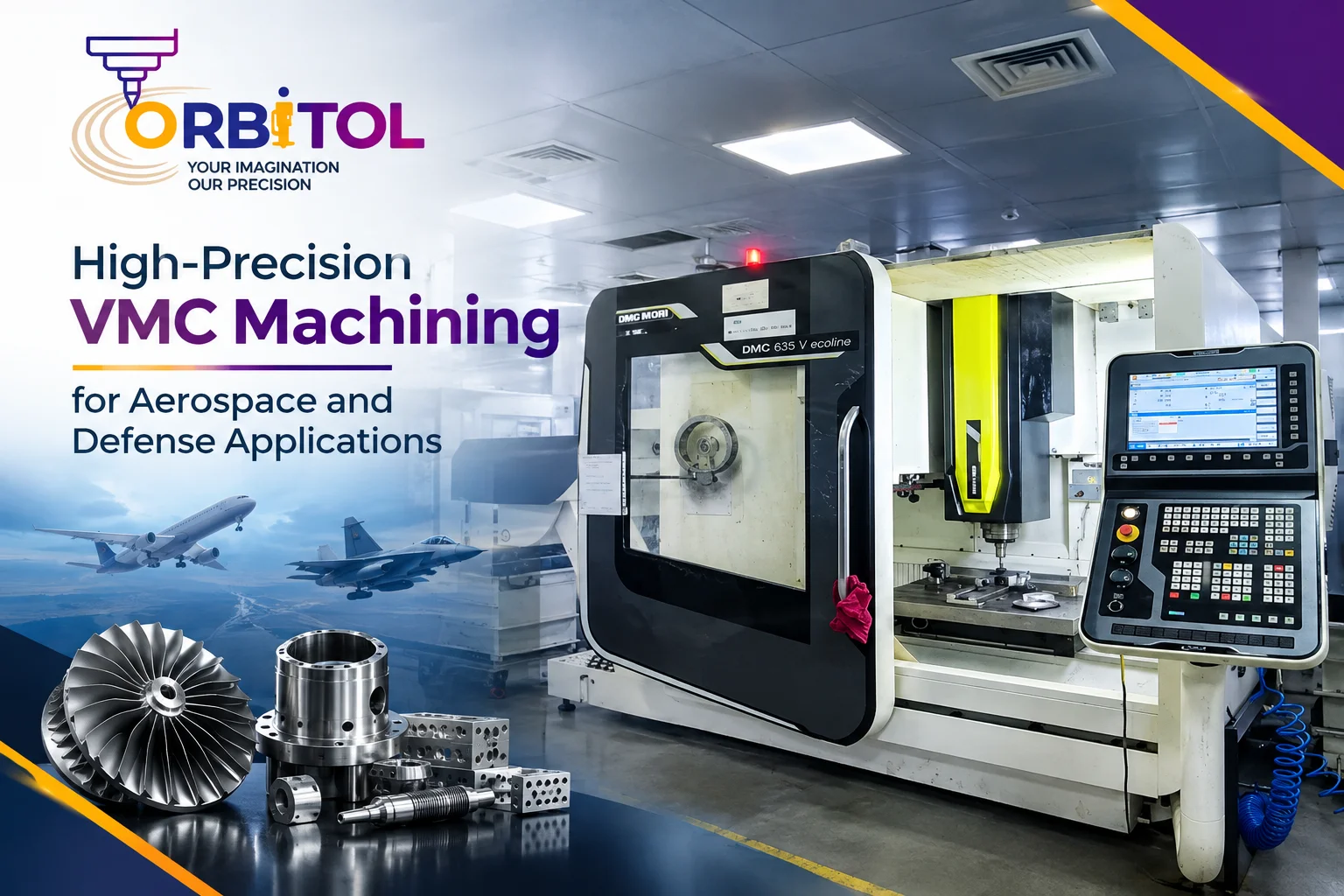
DMG MORI 635 V ECOLINE – 3-axis VMC for precision machining
DMG MORI SPRINT 20/8 – Swiss-type machining
TORNOS Swiss ST 26 – multi-axis Swiss-type machining
The DMU 50 features a high-speed spindle, a 20-tool magazine and one-setup machining capabilities for complex geometries. Meanwhile, the 635 V ECOLINE handles conventional 3-axis machining requirements.
This combination allows Orbitol Intelligence to select the machining process according to each component’s requirements. For example, a complex aerospace component with angled surfaces may benefit from 5-axis machining, whereas a prismatic component with straightforward features may be better suited to a 3-axis VMC.
Orbitol also highlights CAD/CAM integration, real-time quality monitoring and precision inspection as part of its manufacturing capabilities.
This engineering-focused approach is important for customers looking for a High Precision Machining Company. For prototype development as well as production requirements.
8. Quality Control in Aerospace Component Manufacturing
Merely achieving machining precision does not assure. That an aerospace part will be correctly made.
Quality must be appropriate all through the production process.
The first step of the process involves studying the technical drawing and determining the necessary dimensions. Some examples of these are diameters of any holes. Positional tolerances, flatness, concentricity, surface finish and profile.
Meanwhile, manufacturers should monitor tool and machine conditions throughout production. Tool wear can gradually influence dimensions and surface quality, especially during longer production runs. After machining, quality inspectors verify whether the finished component meets the specified requirements.
A reliable quality process can include
- Drawing and specification review
- Machine setup verification
- Tool condition monitoring
- In-process inspection
- Final dimensional inspection
- Surface-finish verification
- Production traceability
Orbitol Intelligence highlights in-process quality control, inspection systems and real-time quality monitoring within its precision manufacturing capabilities. For Aerospace Components Manufacturing. This controlled approach helps improve repeatability and reduces the risk of dimensional variation between components.
The objective is not simply to manufacture one accurate component. Establish a process capable of producing consistent components according to the required specifications.
Conclusion
Aerospace and defense manufacturing requires a combination of precision, repeatability and process control. Complex geometries, tight tolerances and demanding materials make the selection of machining technology an important part of component development.
VMC Machining provides manufacturers. With a controlled method for producing precision milled components. When combined with suitable CAD/CAM programming, tooling, work holding and inspection, it can support the production of components with demanding dimensional requirements.
Additionally, 5-axis machining can reduce setup requirements for more complicated geometries. and provide better access to angled, curved and multi-sided features. At the same time, 3-axis VMC technology remains valuable for many conventional precision components.
At Orbitol Intelligence, the combination of 3-axis and 5-axis VMC machining. Swiss-type machining, precision inspection and engineering-focused production supports different aerospace and defense manufacturing requirements. The company’s listed capabilities. Include ±5 micron tolerances, one-setup machining for complex geometries and advanced CNC/VMC technologies.
For manufacturers looking for reliable Aerospace Components Manufacturing. The key is not simply choosing a machine with advanced specifications. It is choosing the right combination of machine capability, process planning, tooling, programming and quality control for the component.
Orbitol Intelligence Precision Engineering for Mission-Critical Components.