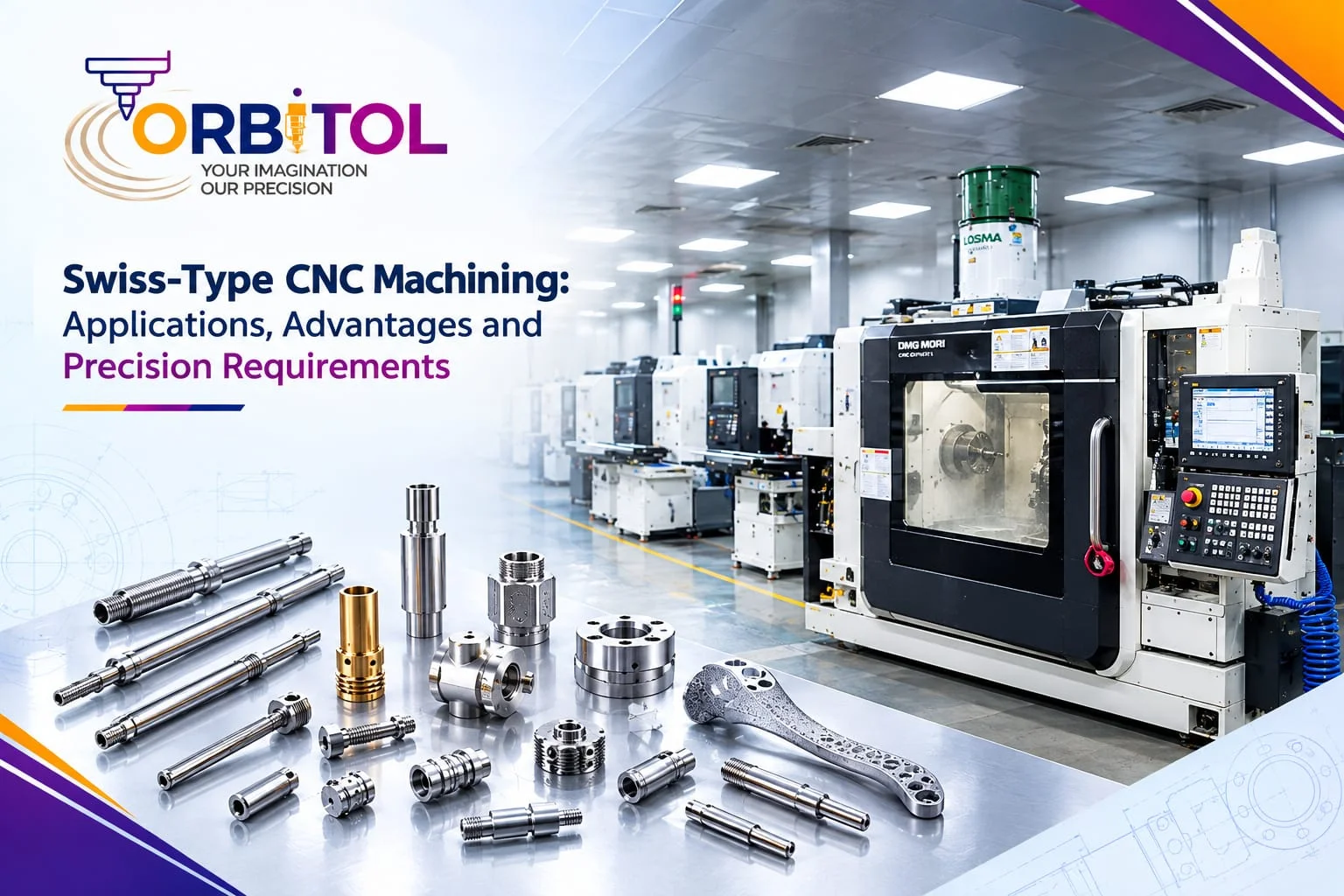
Swiss-Type CNC Machining, In modern production techniques, the crucial nature and function of minute parts becomes apparent Small shafts, pins, surgical screws, and precision fasteners may look simple, but their making requires thorough dimensional control and machining stability.
Even the smallest deviation from an ideal size and shape can lead to an incorrect operation of the component in question. Things become more complicated with the slope bodies or those that have, for instance, nuts, holes, and differently sized diameters.
This is where Swiss-Type CNC Machining becomes an important manufacturing solution.
Unlike conventional turning, Swiss-type machining is designed to handle small-diameter and complex components by supporting the workpiece close to the cutting area. This arrangement helps reduce deflection during machining and supports consistent production.
At Orbitol Intelligence, Swiss-type sliding head machining forms part of a broader precision manufacturing capability, supporting the production of intricate components for demanding industrial applications.
Table of Contents
- What Is Swiss-Type CNC Machining?
- How a Swiss Turning Machine Actually Works?
- Applications of Swiss-Type CNC Machining
- Advantages of Swiss Precision Machining
- Precision Requirements in Swiss-Type Machining
- Why High Precision CNC Machining Depends on the Right Setup
- Precision Turning Materials for Complex Industrial Components
- Choosing a Partner for Precision Swiss Machining
- Conclusion
What Is Swiss-Type CNC Machining?
Swiss-Type CNC Machining is a turning process. Where the work piece slides through a guide bushing. While the cutting tool stays close to that support point. That single detail the guide bushing is what really sets it apart from conventional turning. On a standard lathe, the bar stock is only held at one end. Which means long or thin parts tend to flex or chatter under cutting pressure. Using a Swiss-type machine, the part is secured exactly in the cutting area. There’s practically no dimensional distortion.
This factor is of great importance when the demand for accuracy is placed. On very thin items (of a few millimeters diameter). This technique is extremely useful with regard to the parts that need to be thin and. At the same time, to remain completely round and accurate on the whole length.
How a Swiss Turning Machine Actually Works?
A Swiss Turning Machine feeds bar stock through the guide bushing in small, controlled increments. While the cutting tool remains fixed close to that support. Instead of the tool moving in toward a stationary part like on a regular lathe. Here it’s really the material itself that moves axially through the bushing. With the tool doing precise, localized cuts as the bar advances.
Modern machines take this a step further by combining turning with milling. Drilling, and even secondary operations like threading or cross-drilling all in the same cycle. Often with multiple tool stations working almost simultaneously. That means a finished part can come off the machine ready to go. Without needing a second setup on a different machine. This is a huge part of why Swiss-type machining pairs so naturally with tight-tolerance, high-volume production.
Applications of Swiss-Type CNC Machining
Due to its capability of producing complex small and precise components. Swiss-type machining is used in many industrial sectors
- Medical devices – screws for bones, instruments for surgery, catheters, and implants. With precision that impacts the well-being of patients.
- Electronics and connectors – small pins, contacts, and enclosures. That have to be manufactured consistently in thousands of copies.
- Aviation – small fasteners and fittings that are compliant. With strict tolerances despite their dimensions.
- Firearms and defense – small precision components. Where fit and function can’t afford any variation.
- Automotive – fuel system components, sensor housings, and other small parts. That need to perform reliably under pressure or vibration.
Basically, wherever a part is small, geometrically complex, and needs to be dimensionally perfect. There a good chance Swiss-type machining is involved somewhere in its production.
Advantages of Swiss Precision Machining
There’s a reason so many manufacturers lean on Swiss Precision Machining for their most demanding parts. A few of the biggest advantages
- Exceptional dimensional accuracy – the guide bushing support means minimal deflection. Even on long, thin parts.
- Great surface finish – less vibration during cutting translates directly into smoother surfaces. Often reducing or eliminating the need for secondary finishing.
- Higher throughput for small parts – with multiple tools working in the same cycle. Cycle times per part drop significantly compared to conventional turning.
- Less material waste – bar-fed operation means minimal scrap between parts.
- Complex geometry in one pass – turning, milling, drilling, and threading can often all happen. Without moving the part to another machine.
- Consistency across large batches – once a program is dialed in, part-to-part variation stays remarkably low. Even across thousands of units.
For manufacturers producing small components at volume. These advantages usually add up to lower cost per part without sacrificing quality which is exactly the combination most production runs are chasing.
Precision Requirements in Swiss-Type Machining
Given how small and detailed these parts usually are, precision requirements in this space tend to be strict and for good reason. Many Precision Turned Components made on Swiss-type machines need tolerances in the range of a few microns, especially for medical or aerospace applications.
A few factors that go into hitting those numbers consistently
- Machine rigidity and thermal stability – even tiny temperature shifts in the shop can cause measurable dimensional drift, so many Swiss-type shops run climate-controlled environments.
- Tooling quality and tool wear monitoring – worn tooling on a part this small shows up fast, so tool life tracking and timely replacement are critical.
- Guide bushing condition – since the bushing is what supports the work piece, any wear there directly affects the final part’s accuracy.
- Programming precision – CNC programs need to account for material spring-back, tool deflection, and thermal expansion, especially on harder materials.
- In-process inspection – many shops use in-machine probing or statistical process control to catch drift before it becomes a rejected part.
Get any one of these wrong, and even a machine capable of incredible accuracy. Will start producing parts that drift out of spec.
Why High Precision CNC Machining Depends on the Right Setup
It’s tempting to think that High Precision CNC Machining is purely about the machine itself, but that’s only part of the picture. The setup tooling, fixturing, guide bushing selection, and program optimization plays just as big a role as the equipment.
A Swiss-type machine that’s perfectly capable of holding a few microns of tolerance will still produce inconsistent parts if the guide bushing is worn, the coolant isn’t managed properly, or the tool paths haven’t been optimized for the specific material being cut. This is really why experience matters so much in this field a shop that’s run thousands of similar jobs will catch problems that a newer operation might miss entirely.
Precision Turning Materials for Complex Industrial Components
Swiss machining can use many different types of materials, and the correct material is usually determined according to its application:
- Stainless steel – common in medical and food-grade applications thanks to its corrosion resistance.
- Titanium – used heavily in medical implants and aerospace parts where strength-to-weight ratio matters.
- Brass and copper – alloys are very widely used materials for a number of electronic applications due to their excellent machinability and conductivity,
- Aluminium – Is light and can be machined easily, which makes it suitable for use in automotive and other engineering features.
- Engineering plastics –These materials are well suited to applications where light weighting, insulation, or price is prioritized over strength.
Different materials behave differently when exposed to the tooling equipment, meaning that often enough the programming and tooling strategies will need to be adjusted between each application, even when using the same machine.
Choosing a Partner for Precision Swiss Machining
Because precision machining requires accurate tools as well as significant knowledge of programming, it is important to choose the right manufacturing partner. When you research various companies involved in precision Swiss machining, it is advisable to pay attention to their machinery (single-spindle vs. multi-spindle) as well as their material experience, inspection process, and whether or not they have experience with your part.
This is an area where Orbital Intelligence has built a solid reputation. Orbital Intelligence combines modern Swiss-type equipment with experienced programming and tight in-process quality control, which means parts come off the line consistent, accurate, and ready for use without unnecessary rework. Whether you need small Precision Turned Components for medical devices or high-volume connector parts for electronics, working with a partner like Orbital Intelligence takes a lot of the guesswork out of getting these small, complex parts right the first time.
Conclusion
Swiss-Type CNC Machining has earned its place as one of the most reliable ways to produce small, complex, high-precision parts at scale. The guide bushing support that defines a Swiss Turning Machine solves a problem conventional lathes simply can’t be keeping long, thin parts accurate and stable through every cut. Combined with the ability to handle turning, milling, and drilling in a single cycle, it’s easy to see why so many industries depend on Swiss Precision Machining for their most demanding components.
As parts keep getting smaller and tolerances keep getting tighter, the manufacturers who invest in the right Swiss-type equipment and partner with experienced teams like Orbital Intelligence will be the ones consistently delivering Precision Turned Components that meet spec the first time, every time. Whether you’re in medical devices, electronics, aerospace, or precision engineering, understanding what Swiss-type machining brings to the table is worth the time, because getting these small parts right often makes all the difference in how the final product performs.