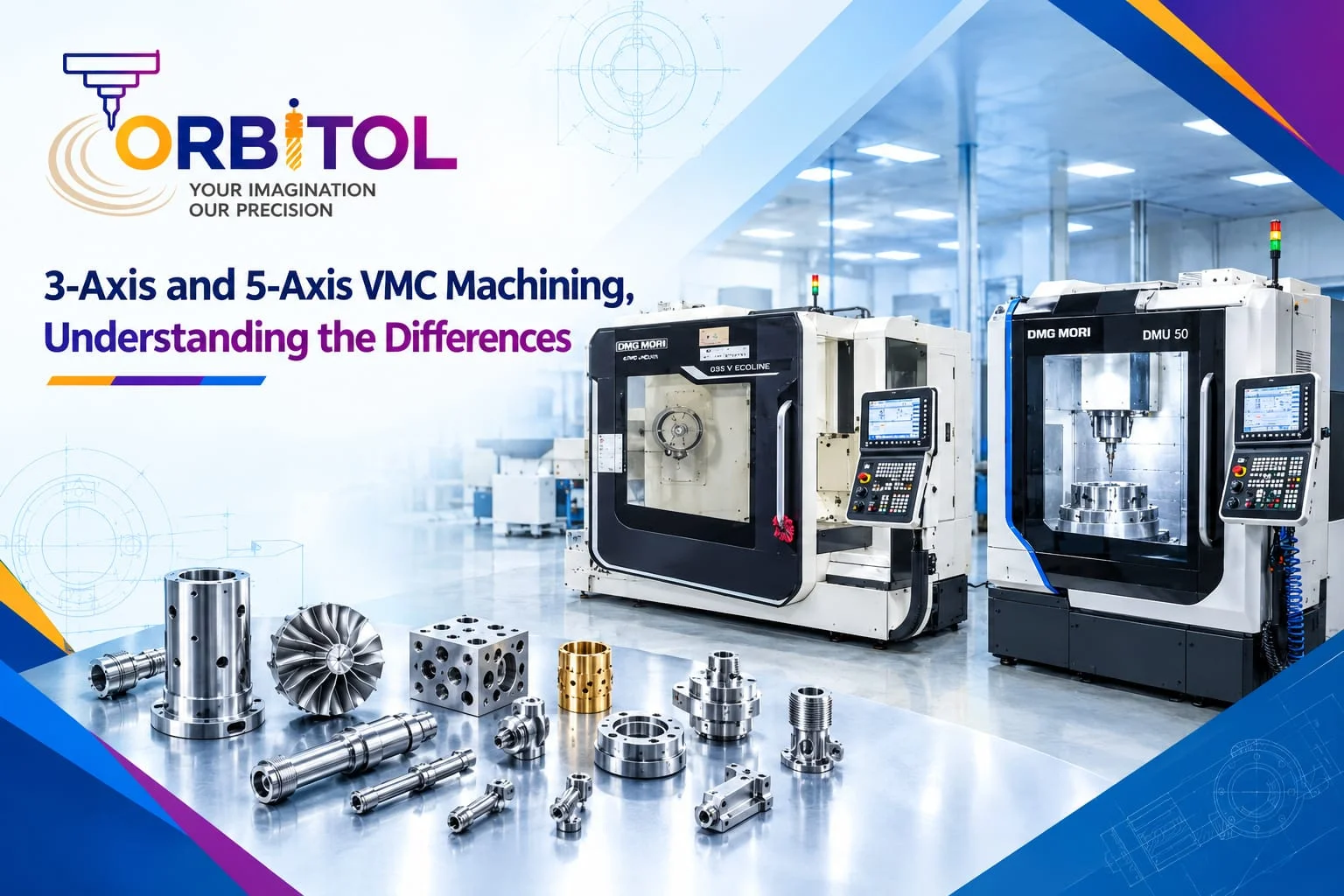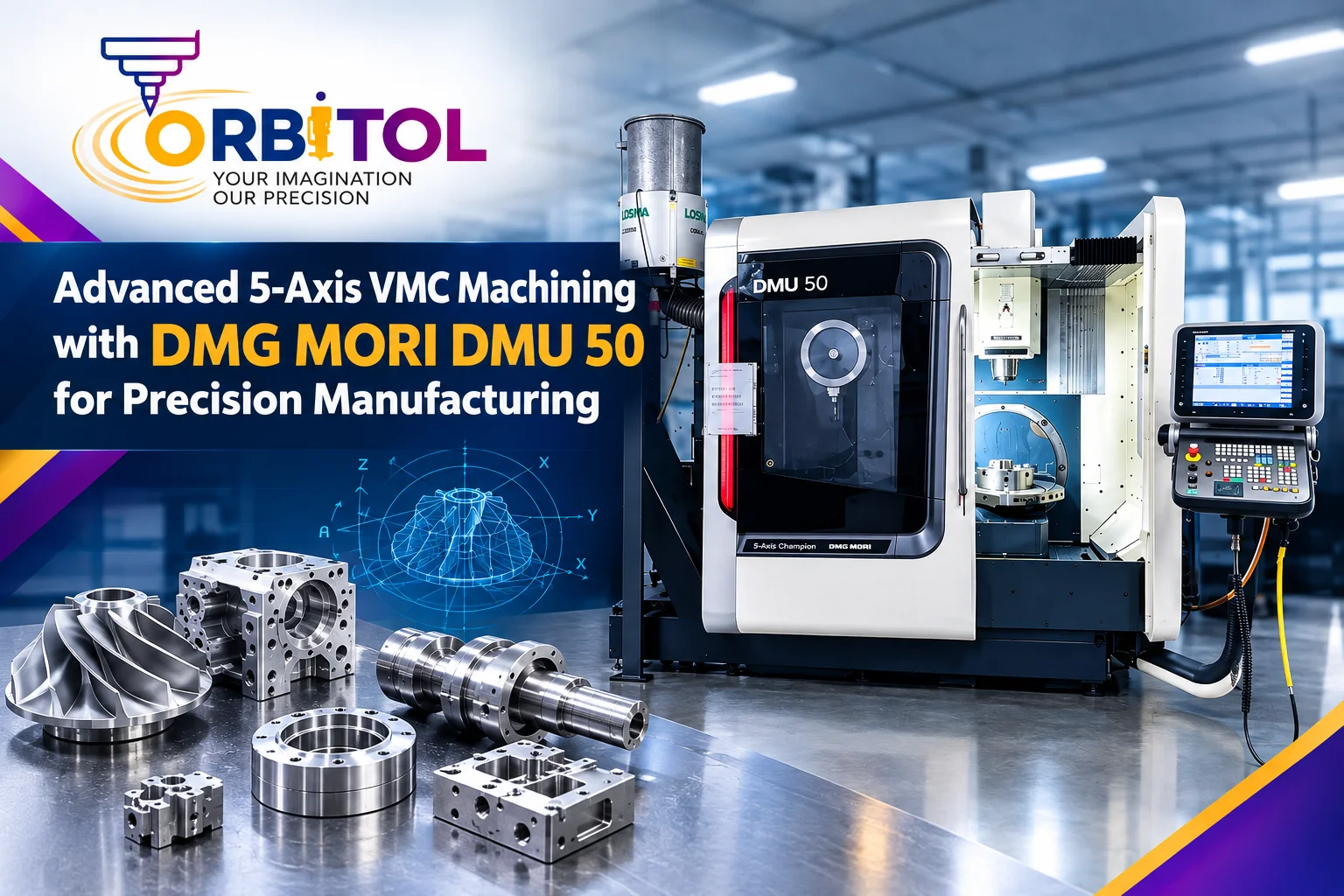
3 Axis and 5 Axis VMC Machining has got a huge change in recent times as manufacturers. Have started using complex components that require precise machining. The simple design of a component may create problems. While machining due to its angular features or complex shape. This is where the difference between 3-axis machine and 5-axis machine becomes crucial.
Both these techniques are commonly used in manufacturing; however, they are applied in different situations. A 3-axis machine is enough when all features of the component can be machined from one side. However, while working on a piece consisting of different surfaces, including complex angles, one needs to have a 5-axis machine.
This choice cannot simply be made on whether to get a machine that has more axes. You should think of the design of the part, the required precision, accessibility of tools, volume of production and organization of the process while making the right decision.
The article will discuss the specifics of 3 Axis and 5 Axis VMC Machining, the differences between these two processes as well as the fields where they can be applied.
Table of Contents
- What Is 3 Axis and 5 Axis VMC Machining?
- What Is 5-Axis VMC Machining?
- 3 Axis vs 5 Axis Machining: Key Differences
- Understanding Multi-Axis Machining
- Precision, Accuracy, and Surface Finish
- Applications of 3 Axis and 5 Axis VMC Machining
- How to Choose Between 3 Axis and 5 Axis VMC Machining
- Conclusion
1. What Is 3 Axis and 5 Axis VMC Machining?
The mechanism of a 3Axis Machining Center operates in three major axes X, Y, and Z for moving the tool in the required. Form to cut through the raw product and remove any required material thanks to the previously programmed operation sequence.
In basic 3 Axis setup, the item is placed on a table and fixed. While the cutting tool can operate in all three axes. This design is helpful due to the fact. That the product’s important characteristics can be produced using one primary machining direction.
VMC can cover a wide range of different machining processes such as face milling, pocketing, slitting, drilling contouring, etc. And produce efficient machining results when combined with proper tooling and cutting process considerations.
Another reason manufacturer continues to use a 3 Axis Vertical Machining Center. Is its straightforward setup. Programming and work holding are generally less complicated than. They can be with more advanced multi-axis systems. For components with flat surfaces, holes, pockets, steps, and relatively simple profiles. This can make the machining process efficient and practical.
When the piece possesses notable features on various surfaces. The limitations become apparent. A piece having deep cavities, slanted surfaces, undercuts, and complex 3D profiles might necessitate changing locations several times. Each additional process results in longer handling time and careful orientation. Thus, while 3-axis machining has great capabilities. Its usability depends on the ease of accessing the relevant features.
2. What Is 5-Axis VMC Machining?
A 5-axis machine offers two types of rotating movements in addition to the usual three movements. This rotation may be made by the head of the machine or from a table or from both of them.
The most significant difference is that the tool is free to move in relation to the work piece. Instead of using a machine from one direction only. The tool may work from different points. This is particularly useful. When making an item that has features on various surfaces or hard-to-reach surfaces. Instead of taking the piece out of the machine each time, many features. Can be made one set-up.
This does not mean that every 5-axis machine is used for simultaneous five-axis cutting. 3+2 machining is also common. In this method, the rotary axes put the tool or item at a certain angle, after. Which the linear axes perform the cutting process. In the case of 5-axis milling. There is a possibility of simultaneous movement of several axes. When the tool follows a continuously changing trajectory. Additional movement is very important. When producing molds, stamps, aircraft parts, medical devices, vehicle parts, and any other components. With complicated surfaces.
As far as these processes are concerned, the most significant advantage is not only the presence of two additional axes. But also a greater scope of movement for effective machining of the component
3. 3 Axis and 5 Axis VMC Machining, Key Differences
To make it simpler, one can say that one will be able to distinguish between. 3 Axis and 5 Axis VMC Machining if one analyses how the operation of the cutting instrument is conducted.
3-axis machining has three working units, i.e. X, Y, and Z. During the operation. The item remains in one position everywhere. In case of machining other surfaces of the component, the machined item. Will have to be taken from the machine, repositioned, and put back into the machine again. In some cases, it can be an inconvenience. While for simple components, 3-axis machining can be a 3-axis setup can be fast and efficient.
The situation changes when a component has several machining faces or difficult angles. A part that requires four or five separate setups on a 3-axis machine may be completed. With fewer setups on a suitable 5-axis machine. The additional rotary movement also improves tool accessibility. Instead of relying on a very long tool to reach a deep or angled feature, the machine may be able to tilt the tool into a more suitable position. A shorter tool can provide better rigidity in applications. Where tool length is a concern. There is another important point, though. The use of more axes in a machine is not always synonymous. With better machining. In fact, a 5-axis machine involves a lot of programming, effective CAM strategy, and post-processing and the operator has to get well accustomed to the new functioning of the machine.
For example, when one simply needs a bracket, using a 5-axis machine is an unnecessary complication. But if one has to produce some work pieces. With several inclined faces and recessed parts. Having additional capabilities. Will be extremely helpful. Thus, the right decision requires analyzing the specific part rather than just being guided by the number of axes.
4. Understanding Multi-Axis Machining
Multi-Axis Machining becomes possible due to the use of advanced CNC machinery. That is capable of performing movements other than three linear ones. Additional rotary movement facilitates the change of the position of either the work piece or the cutting tool.
As the goal is very simple: let the tool reach the work piece more effectively. Take an instance of such a component. That has holes made at different angles. On a 3-axis machine. One has to change the position of the work piece every time one has to make a corresponding change in the orientation. It may take That takes time and requires the operator to establish the correct alignment again. In cases where multi-axis configuration is used appropriately. The machine can reposition the selected point on the item. Without taking it out of the clamp.
The concept remains applicable to the processing of curved surfaces. Oblique walls, and deep recesses, thus eliminating the need to change the position of the cutter and enabling the machine to use the required approach angle. This is one of the reasons multi-axis technology is often associated. With complex component manufacturing. It provides flexibility. Where a fixed tool direction. Would otherwise make machining more complicated.
However, multi-axis machining is not automatically necessary for every job. If a component can be completed efficiently on a 3-axis machine. There may be little reason to introduce the additional programming and setup requirements. Of a more advanced system.
5. Precision, Accuracy, and Surface Finish
When comparing three-axis to five-axis machining. One of the first things that manufacturers think of is accuracy. However, just knowing. How many axes a machine has does not give enough information about the accuracy. Of the part being machined. The status of the machine, rigidity, spindle performance, tools, work holding devices, programming, cutting methods, material, and temperature of the material. Will all affect the quality of the machined part. Under the current circumstances, a well-maintained three-axis machine can produce components. With high accuracy if the geometry permits. However, problems arise. When several repositions of the part are needed.
A 3 Axis and 5 Axis VMC Machining can reduce. This issue on suitable multi-sided components by allowing more features to be machined. Without removing the work piece from its original setup. The angle at which you approach the surface. Can also modify the cutting process. The cutting tool may be applied at a more favorable angle. Which allows for the use of shorter tools. With satisfactory cutting conditions.
This can particularly help in the case of machining rounded surfaces or surfaces. That have a number of curves in their shapes. Instead of one fixed angle of machining. The tool can be relocated. Always remember that precision in VMC machining depends on the overall manufacturing process. 3 Axis and 5 Axis VMC Machining calibration, status of tools. Work holding, usage of cutting fluids, cutting conditions, thermal stability, and monitoring. You should not assume that using 3D and 5D machines is a shortcut to perfect machining. Everything must be clearly organized. From the very beginning of the process.
7. Applications of 3 Axis and 5 Axis VMC Machining
Both 3-axis machining and 5-axis machining. Are important processes in modern manufacturing.
3-axis machines are often suitable for parts. That have easy surfaces and simpler geometries. Brackets, plates, enclosures, jigs, tools, cavities, slots, and many typical precision parts. Can be manufactured using this method.
3 Axis Vertical Machining Centers also apply to manufacturing dies and molds. Where the required profiles, holes, and cavities can be achieved. With a simple tool orientation. 3 Axis and 5 Axis VMC Machining. Becomes more useful as the geometry becomes more demanding. Aerospace components, medical parts, automotive components, moulds, dies, turbine-related components, and other intricate parts. Can benefit from the ability to approach different surfaces and angles.
Moulds and dies can be good examples of this work. The cavities of some moulds can have complex 3D surfaces. That cannot be easily machined using a fixed tool orientation. The capability of reorienting the tool makes reaching. The places easier and the finishing more efficient. 3 Axis and 5 Axis VMC Machining, Aerospace parts. Can be similar in that they can have complex geometries. And several faces and angled features have to be processed properly and remain in the proper relation to each other. That applies to medical devices as well as to precision-engineered parts. If the design has some details or features located on different surfaces. Then the machining can become less complicated. With the addition of flexibility.
8. How to Choose Between 3 Axis and 5 Axis VMC Machining
One must begin from the part being machined.
If the part is such that all required operations. Can be performed from one side, a 3-axis machine may be all that is required. One can achieve a relatively simple setup. Straightforward programming, and successful processing of the desired component. With a 3-axis machine. On the other hand, if there are many inclined surfaces. Deep holes, complicated shapes, or features on different surfaces. Of the part, a 5-axis machine could be a better option.
You need to consider how many setups you will need. If you will be taking the work piece out and putting it back multiple times during the process of machining. On 3-axis machines, you might want to consider switching to 5-axis machining. Tool accessibility is another factor. Deep pockets can sometimes force a 3-axis machine to use longer tools. Longer tools can be more susceptible to deflection. Depending on the application. A different tool angle on a 5-axis machine. May allow a shorter and more rigid tool to be used.
Production quantity also matters. If focus is put on repetitive manufacturing. Then cutting down setup and processing time is naturally important to overall performance. When dealing with non-repetitive or quite simple parts. 3-axis technology may prove to be more efficient though. In addition, think about the level of programming knowledge and technical experience. That is available. A 5-axis apparatus is going to need the most appropriate. CAM software, post-processing techniques, simulation methods, methods of securing work pieces. Tools and specialists in the field of process planning.
Conclusion
Understanding 3 Axis and 5 Axis VMC Machining. Is not really about crowning one technology the winner. It is about matching the right process to the part in front of you. 3 Axis and 5 Axis VMC Machining remain a genuinely efficient, capable choice for plenty of components. With accessible surfaces and straightforward geometry. It’s a familiar approach, and it delivers excellent results. When the part actually suits the process.
5-axis machining brings another layer of flexibility by letting the relationship. Between tool and part shift through added rotary movement. That makes multi-sided, contoured, and complex parts a lot easier to produce often. With fewer setups and better tool accessibility along the way.
Multi-Axis Machining becomes especially important in cases. Where conventional setups cannot be used, due to logistics difficulties. However, not all parts are as complex and need five axes; thus trying to think in such terms is needless and leads to higher costs and unnecessary complications. The key to finding the right solution is geometry, tolerance, tooling, material, production volumes, setup requirements, and the machining process itself. When it comes to Precision VMC Machining, the knowledge of the above aspects of the process is crucial. For a manufacturer to select the best technology for each particular component. Regardless of whether conventional milling is used or Complex Component Machining, the goal of the manufacturer must remain the same.