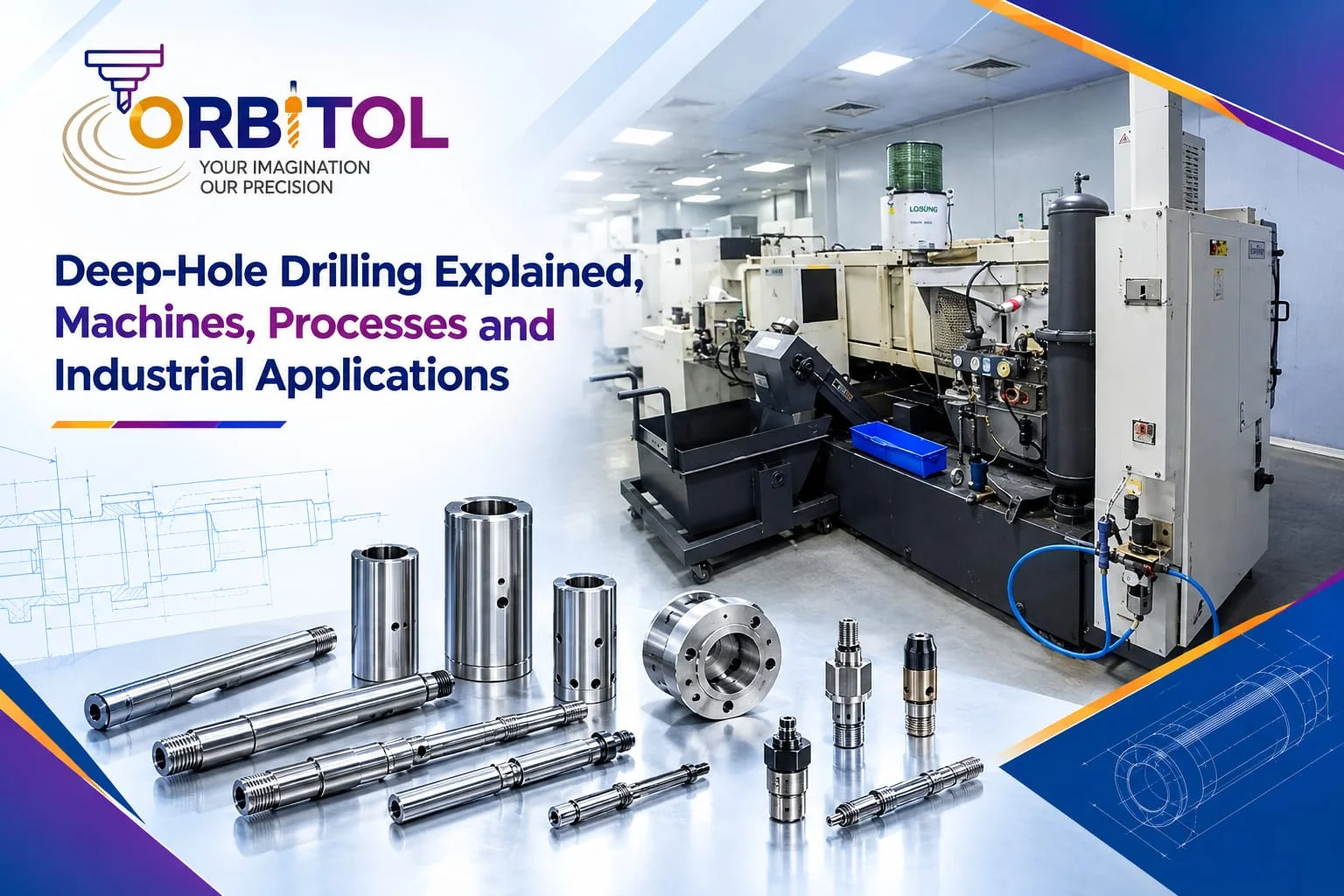
Deep hole drilling is a specialized machining process used to create deep, accurate holes in components. Where conventional drilling methods may not provide the required precision or consistency. The process is widely used for manufacturing moulds, dies, hydraulic components, automotive parts. Aerospace components, and other precision-engineered products. Depending on hole dimensions, machining technology can be selected and alternatives used. The most popular method for producing straight and perfectly concentric boreholes is gun drilling. The effectiveness of deep hole drilling depends on several aspects. Such as coolant flow and disposal, chip removal, tool positioning, and cutting parameters. The article aims to give information about deep hole drilling: the types of machines. Applied in the technology, the procedure, the main drilling techniques used. And the fields of application of this method.
Table of Content
- Understanding Deep Hole Drilling and Its Importance
- Types of Deep Hole Drilling Machines and Processes
- Key Factors Affecting Precision and Hole Quality
- Industrial Applications of Deep Hole Drilling
- Choosing the Right Deep Hole Drilling Solution
What Is Deep Hole Drilling and Why Does It Matter?
Some components need a hole that is far deeper than it is wide. That’s where Deep Hole Drilling comes in. As the depth-to-diameter ratio grows, ordinary drilling gets harder. Keeping the hole straight, controlling tool deflection, clearing chips and managing heat all become real problems. Deep hole drilling technology exists to solve exactly those problems on long, precise holes.
In most manufacturing settings, a hole is called deep once the ratio goes beyond about 10:1. The exact threshold varies from job to job, depending on the operation and the method used. With the right machine, tooling and coolant system, deep hole drilling can reach much higher ratios.
The goal isn’t just to reach the required depth. The bore also has to do its job once the part is in use.
A standard twist drill works well for everyday drilling. Deep holes ask for more: better chip removal and better tool guidance. Chips have to leave the hole quickly instead of piling up at the cutting zone. Coolant matters just as much, since it controls temperature and helps flush the chips out.
This is why a dedicated Deep Hole Drilling Machine makes sense. These machines are built for the job, with special tooling, high-pressure coolant systems, filtration, proper workholding and controlled tool movement. For anyone making moulds, dies, automotive parts, hydraulic components or other precision-engineered parts, choosing the right deep hole technology has a direct effect on the end result.
2. Types of Deep Hole Drilling Machines and Processes
Deep-hole machining isn’t one single technique. The right process depends on hole diameter, hole depth, component geometry, material, precision requirements and production demand. Gun drilling and BTA drilling are the two methods you’ll see most often.
Gun drilling
Gun drilling is a well-known method for long, straight, accurate holes, especially at smaller diameters. A gun drill has a specialised cutting geometry and guide pads that support the tool as it moves through the component. Coolant is pushed through the tool, and the chips are carried out along the drill’s flute.
This self-guiding action helps the bore stay on course, and the guide pads also help the internal surface finish. Cutting, guiding and coolant delivery all work together, which is why gun drilling is so closely linked with precision deep-hole work. A Gun Drill Machine is built around this exact operation. Depending on the machine, the workpiece may stay still while the tool rotates, or tool and component can move in other combinations. The setup is chosen based on the component size and the application.
CNC gun drilling machine
A CNC Gun Drilling Machine adds computer-controlled positioning and movement to the process. That’s especially handy when a part has multiple holes, angled hole locations or repeat production requirements.
Dedicated CNC gun drilling systems can include servo-driven linear movement, high-pressure coolant, filtration and support for multiple tools. The Precihole gun-drilling range, for example, includes configurations for different hole diameters, depths and component sizes. Choose the machine specification from the component drawing and the process requirement, not by simply going for the biggest capacity available.
BTA drilling
For larger-diameter holes, BTA (Single Tube System) drilling is often a better fit than gun drilling. Here, coolant flows around the outside of the drill tube, and the chips come out through the inside of the tube. This gives a rigid setup that suits bigger holes and higher material removal.
BTA machines are commonly used for larger shafts and industrial components, and machine models can handle a wide range of diameters and depths. So the choice between gun and BTA drilling should come down to hole diameter, hole depth, material and the production efficiency you need.
3. Key Factors Affecting Precision and Hole Quality
Precision deep hole drilling involves more than just using the appropriate drill. It takes into account the entire component, including the tool geometry, machine rigidity, incorporated coolant delivery, work holding methods, parameters of the cutting process, and control technologies.
Straightness and accuracy
Straightness is one of the key parameters in deep-hole machining. The deeper you drill, the more the tool can drift, and that deviation shows up where the hole exits on the far side.
Specialised deep-hole machines use tool guidance and support systems to keep this under control. Some configurations also rotate or counter-rotate the component to improve drilling behaviour. Dedicated systems can hold bore straightness and repeatability over long depths.
Decide the required accuracy before machining begins. A drawing may call out bore diameter tolerance, straightness, roundness or surface finish, and those requirements should guide your choice of process.
Coolant and chip evacuation
Coolant management is critical here. The deeper the tool goes, the harder it is to reach the cutting zone, and the heat generated still has to be controlled.
High-pressure coolant systems can deliver coolant straight to the cutting area while helping to clear chips. Fine filtration is essential in systems that keep recirculating coolant, because contamination can disrupt both the process and the equipment. Gun drilling relies on coolant supplied through the tool, while drilling uses a different coolant and chip removal arrangement.
Tool support and machine stability
While drilling deeper holes, it must be understood that machine rigidity and tool holding become increasingly important. A long and thin tool is far more responsive to vibration and deformation than a shorter one. Thus, it is necessary to use proper device holders and ensure that the component is firmly fixed during the entire machining process.
Material counts too. Different steels, alloys and engineering materials produce different chip shapes and cutting behaviour, so tool selection and cutting parameters should be set for the actual workpiece material.
Inspection and process control
One of the most significant aspects of precision drilling is the actual measurement of the finished hole. When it comes to the manufacturing of various components, the technique of drilling should be selected according to the method of the component manufacturing process. Keep an eye on tool condition, coolant condition, machine setup and machining parameters throughout the run.
When all of these factors are managed together, Precision Drilling becomes a controlled manufacturing operation instead of just a hole-making step.
4. Industrial Applications of Deep Hole Drilling
Deep-hole technology is used wherever components need long internal bores with controlled dimensional and geometric characteristics. The exact drilling method depends on the component and its engineering requirements
Automotive components
Automotive manufacturing involves many parts that may need deep or accurately positioned holes. Shafts, transmission-related components, hydraulic parts and other precision-engineered components can all call for specialised drilling.
A CNC Gun Drilling Machine is useful when repeat production needs consistent hole positioning and controlled machining cycles. Multi-axis configurations can also help with parts that have several hole locations or off-center long holes.
Mould and die manufacturing
Moulds and dies often contain cooling channels that must be positioned accurately inside the mould structure. Deep-hole drilling is used to produce these passages according to the mould design. Large mould bases may need specialised multi-axis drilling machines that can reach different positions across the component, and dedicated configurations exist for drilling deep holes in moulds and other large parts.
The accuracy of these passages affects how well the cooling channels perform, which makes controlled drilling an important part of mould manufacturing.
Hydraulic and industrial equipment
Hydraulic cylinders and industrial equipment can contain deep bores that need controlled internal geometry and surface quality. In these cases, bore accuracy and surface condition can affect how mating components and fluid systems perform. BTA drilling is especially relevant for larger-diameter deep holes and is used in hydraulics, energy, aerospace and other heavy engineering fields.
Aerospace and engineering applications
Aerospace and high-technology products often use specific materials and shapes, so the machining parameters have to be chosen carefully. Long holes may be needed in hollow sections or other long features. The process should be selected based on the material, hole dimensions, required tolerances and quality measures in place. Work at this level takes coordination between cutting tools, machine capability and quality control.
Medical and other precision uses
Certain medical, energy and engineering applications also use deep-hole drilling. Requirements vary widely, so pick the process from the technical drawing and specification, not from a routine machining procedure.
Across these sectors, the lesson is the same: choose the right machine and plan the process properly. Precihole, for instance, lists automotive, aerospace, oil and gas, hydraulic, die and mould, energy and medical among the industries served by its deep-hole technologies.
5. Choosing the Right Deep Hole Drilling Solution
Choosing the right Deep Hole Drilling Machine starts with the component, not the machine catalogue. Define hole diameter, drilling depth, component dimensions, material, required tolerance and production quantity first.
For relatively small-diameter deep holes, gun drilling may be a good fit thanks to its tool guidance and coolant delivery. For larger-diameter holes, BTA drilling may be the better solution. Where exactly you switch from one to the other depends on the actual application and available tooling.
Machine configuration matters as well. Small and medium components may need a different arrangement from large moulds, shafts or tube sheets. Multi-axis systems are useful when many hole positions have to be machined on a larger or more complex part.
Production volume should influence the decision too. A machine for occasional work has different requirements from equipment running continuous production. Look at tooling availability, coolant capacity, filtration, machine rigidity, programming capability and maintenance support.
At Orbitol Intelligence, we approach precision manufacturing based on the component and what it needs. We provide CNC and VMC machining, Swiss-type machining, mould and die manufacturing, tool room solutions and precision component manufacturing. We also have a Precihole CNC Gun Drilling Machine capability for deep-hole machining requirements, which lets us treat deep-hole drilling as part of the overall precision manufacturing process and not as a separate, isolated step. If you make tools, dies, automotive parts, hydraulic components or similar products with deep-hole requirements, the best process depends on your drawing and process needs. An experienced machining partner should check hole dimensions, material, tolerances, surface finish and production volume. Successful deep-hole drilling comes from machine capability, tooling, coolant supply, workholding, programming and inspection working together. When these are properly coordinated, Deep Hole Drilling delivers accurate, repeatable internal bores for demanding industrial components