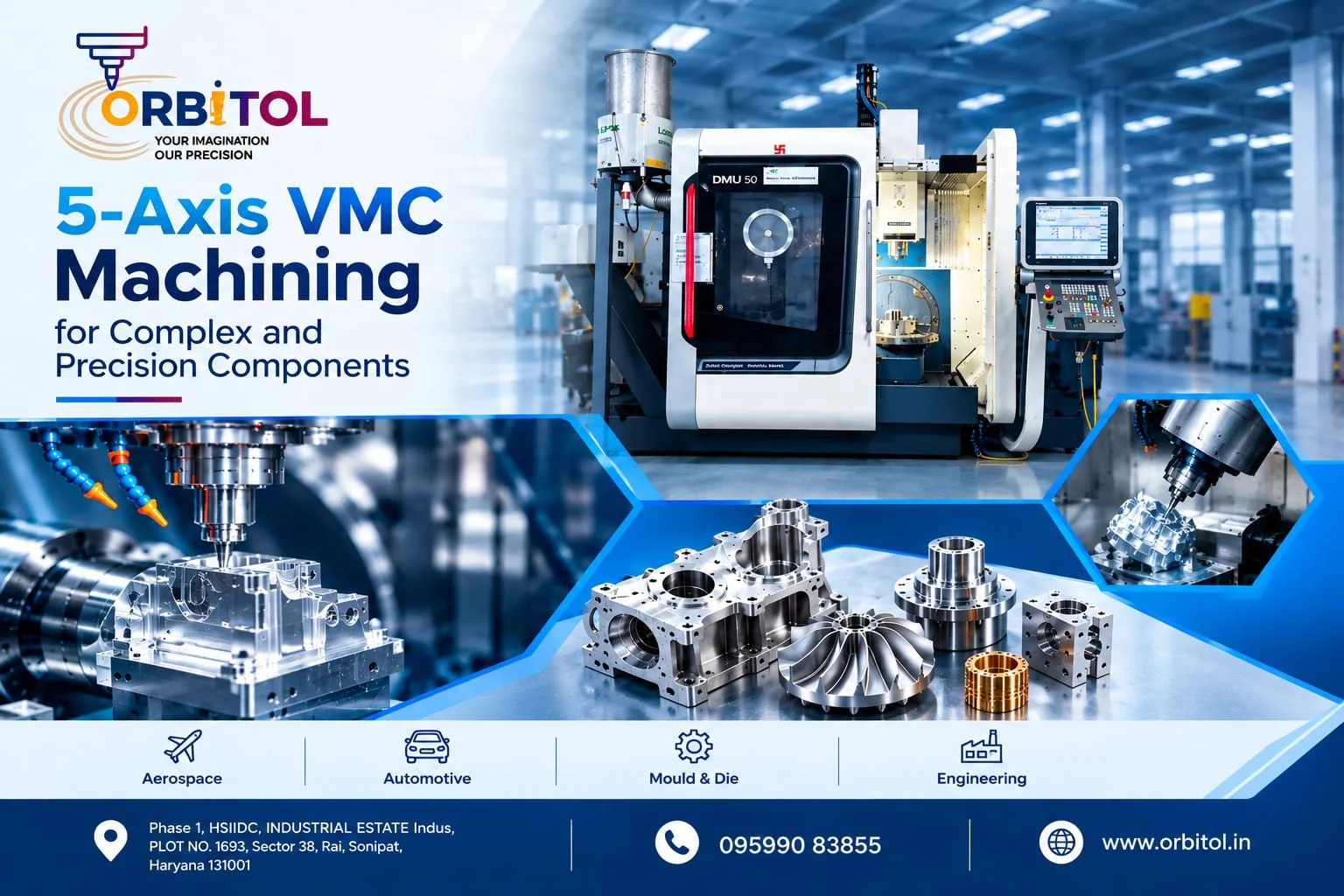
5-Axis VMC Machining, Manufacturing technology has undergone tremendous changes since the time of basic lathes and hand mills. Nowadays if you work in an industry where everything has to meet tight tolerances and shape or form complexities, you have most likely heard about 5-Axis VMC Machining Center machining. Is an advanced manufacturing process designed to produce complex components that are difficult to manufacture using conventional 3-axis machines. Aircraft brackets, healthcare implants, vehicle box casings – all of these elements cannot just be produced with the right precision, being approximately right will simply not work here.
Table of Contents
- Introduction to 5-Axis VMC Machining
- Understanding the Vertical Machining Center
- How Multi Axis Machining Works
- Why High Precision Machining Matters
- The Role of High Accuracy Machining in Modern Manufacturing
- Applications of VMC Machined Components
- 5-Axis vs 3-Axis Machining Key Differences
- Industries That Rely on 5 Axis VMC Machining
- Choosing the Right VMC Machining Partner, Key Factors
- How Orbital Intelligence Supports Precision Manufacturing
- Conclusion
Introduction to 5-Axis VMC Machining
Manufacturers use 5-axis VMC machining to produce complex components that are difficult to manufacture. With conventional 3-axis machines with high precision and dimensional accuracy. By allowing the cutting tool to approach the workpiece from multiple angles, this machining method can reduce setups, improve accessibility, and deliver consistent results for intricate components.
The reason why a five-axis vertical milling machine is very useful. Is quite simple – it can process the workpiece can be machined from multiple angles without repeated manual repositioning. You do not have to use special techniques to flip and hold the work piece. And as product designs keep getting more intricate, shops still stuck on old 3-axis workflows are starting to feel the pinch – longer lead times inconsistent quality, more rework. In this blog. We will walk through how 5-axis technology actually works, why it’s worth the investment, and how a partner like Orbital Intelligence fits into the picture.
Understanding the Vertical Machining Center
Vertical Machining Center (VMC) is a machine tool. With a vertical spindle that moves the cutting tool downward toward the workpiece.That has a vertical spindle which causes the cutting tool to apply downward motion onto the work piece. The basic VMC is equipped with three axes (X, Y, and Z), which allows performing the majority of standard machining tasks. However, in case of processing of curved as well as angled surfaces, the application of a three-axis machining center might complicate. The work due to the fact that many steps will involve using fixtures leading to increased chances of mistakes.
That is exactly where five-axis machining earns its keep. By adding two rotational axes – usually labeled A and B, or A and C, depending on the machine. The tool or the work piece itself can tilt and rotate, opening up access to nearly every surface without anyone touching the clamps in between. It’s a relatively simple concept on paper, but it’s what separates an ordinary VMC from a genuinely advanced 5 Axis VMC Machining setup. Yes, the equipment costs more upfront. Most shops that make the switch don’t regret it for long.
How Multi Axis Machining Actually Works
Multi-axis machining implies that the tool is operated not only along three axis but also includes movements along one or more axes. In the case of 5-axis machining. The operator is responsible for the combination of moving the machine along the linear axes (X, Y, and Z) and moving the spindle in the rotational manner making sure that the cutting tool has the best angle. When operating on the surface of the work piece.
That coordination opens up a lot of possibilities. Complex contours can be cut in one go instead of several. Fewer fixtures are needed. Curved surfaces come out with a more even finish. Deep pockets and undercuts that would be impossible on a 3-axis machine suddenly become routine work. Setup and programming time also shrinks for jobs that repeat.
There is benefit too – because the tool holds an ideal cutting angle throughout. It wears down slower, and cycle times improve compared to constantly repositioning a part. Over a production run, that adds up to real savings, even if the machine itself was pricier to buy.
Why High Precision Machining Actually Matters
Precision is not a marketing buzzword in this world – it is often written into the contract. Aerospace, defense, medical device manufacturing – these industries routinely demand tolerances measured in microns. One small misalignment, and an entire part might be scrap.
This is really where High Precision Machining through 5-axis technology proves its worth. Due to the fact that parts do not change their position. While machines are producing parts around them, the accumulation of errors that happens after several setups is minimized. This is one of the main reasons for the switch of many manufacturers to advanced VMC systems over the last decade.
What does that precision actually buy you? Tighter dimensional tolerances, more consistent results batch after batch, less scrap, better fit between mating parts, and fewer headaches during quality inspection. For anyone producing safety-critical components, this isn’t optional – it is simply the baseline you are expected to meet.
The Role of High Accuracy Machining in Modern Manufacturing
Precision and accuracy get used interchangeably a lot, but they are not quite the same thing. Precision is about consistency, High Accuracy Machining is about how closely the finished part matches. The original design. In a 5-axis system, that accuracy comes from a mix of things – a rigid machine frame, a capable CNC controller, real-time tool compensation and continuous coordination between all the axes.
Most modern 5-axis VMC systems are equipped with various options that make this achievable. Automatic compensation for tool length and diameter, mechanisms that keep the machine. From shifting due to heating processes occurring, devices that provide feedback on vibration compensation. High-resolution encoders indicating the exact position of the tool and closed-loop systems constantly. Checking the position of the tool. Without at least one of those features a part could be good enough but still fails during assembling. Moreover, there is a possibility of out-failure in the field.
Where VMC Machined Components Actually Show Up
Because 5-axis technology is so flexible, VMC Machined Components end up in more everyday products than most people realize. A few examples
Aerospace parts like turbine blades, structural brackets, and housings that need complex curvature. Medical devices – orthopedic implants, surgical tools, prosthetics. Where biocompatibility and precision both matter. Automotive components, from engine parts to transmission housings to one-off prototypes. Industrial equipment such as pump housings, valve bodies, and gearboxes. With tight internal geometry. Even consumer electronics rely on it, for enclosures and heat sinks that need fine detailing. And increasingly, energy sector components – turbine housings and precision fittings for renewable systems – are being made this way too.
In every one of these cases, the appeal is the same: less setup time, better dimensional accuracy, and parts that come out right the first time.
5-Axis vs 3-Axis Machining, What is the Real Difference?
It helps to see the two side by side.
Feature 3-Axis Machining 5-Axis VMC Machining
Axes of movement X, Y, Z X, Y, Z + 2 rotational axes
Setups required Multiple often Usually one
Complex geometry Limited Excellent
Cycle time Longer (repositioning adds up) Shorter overall
Surface finish on curves Moderate Superior
Cost per part (complex work) Higher Lower long-term
Programming skill needed Lower Higher, specialized
3-axis machines are not obsolete for flat, simple parts, they still do the job fine and cost less to run. But once geometry gets complicated, 5 Axis VMC Machining pulls ahead on nearly every count, speed and accuracy included.
Industries That Lean on 5 Axis VMC Machining
A handful of industries have basically built their production strategy around this technology. Aerospace and defense, obviously. Where every gram and every micron is scrutinized. Medical and healthcare sectors rely on regulatory compliance. Automotive and EV manufacturing, particularly enginery parts, battery enclosure and equipment divisions. Oil and gas industries demand that valves and joints. Withstand significant pressure. Robotics and automation, which depend on tight-fitting custom parts for moving assemblies. Marine engineering, where propeller components and fittings have to hold up against genuinely harsh conditions.
Product designs across these sectors keep pushing boundaries. The demand for shops that can actually deliver reliable multi axis machining keeps climbing right along with it.
Choosing the Right VMC Machining Partner
Not every machine shop that claims 5-axis capability is actually equipped to handle it well. Before committing to a partner for high precision machining, it is worth asking a few pointed questions. Do they run genuine 5-axis Vertical Machining Centers, or are they faking multi-axis moves on older equipment? They have real experience with your specific material – metals and composites behave very differently under high-speed cutting. ISO or sector-specific certifications relevant to your industry? Is their CAM programming team experienced enough to handle the added complexity 5-axis toolpaths bring? And can they actually verify the final part with CMM inspection, not just eyeball it?
A shop that checks all these boxes is far more likely to consistently deliver solid VMC machined components. No matter how tricky the design gets.
How Orbital Intelligence Supports Precision Manufacturing
At Orbital Intelligence, the approach has always been to pair real technical know-how with genuinely capable machinery. When a project calls for 5 Axis VMC Machining, the team works closely. With clients upfront – understanding design intent, how the material will behave, what tolerances actually matter – before any cutting even starts.
Using advanced Vertical Machining Centers, Orbital Intelligence helps. Clients cut down lead times, avoid setup errors, and produce VMC machined components. That hold up to scrutiny, whether it is a single prototype or a full production batch. That mix of solid process discipline and modern equipment is what’s made Orbital Intelligence a name people trust when high precision machining really can’t be compromised on.
As all this matures, 5 Axis VMC Machining is only going to get more accessible and efficient. Which just reinforces how central it’s becoming to high-end manufacturing.
Conclusion
Advanced 5-Axis VMC Machining is not just an incremental upgrade – it is a genuinely different way of approaching complex parts. By cutting down on setup errors and handling intricate geometry in one pass, it solves problems that manufacturers have been wrestling with for decades.
Whatever industry you are in – aerospace, medical, automotive, industrial equipment – investing in high accuracy machining. Through a proper Vertical Machining Center can noticeably improve both quality and turnaround. And working with an experienced partner like Orbital Intelligence. Means your VMC machined components get built right from the first run, saving time, cutting costs, and giving your business a real edge in a market. Where precision increasingly decides who wins the contract.