Precision manufacturing increasingly involves components. With complex geometries, multiple machined surfaces and demanding dimensional requirements. Conventional machining methods can require several setups to complete such components, increasing handling time and the possibility of positioning errors. 5-Axis VMC Machining provides a practical solution for suitable complex components by combining three linear movements with two rotary axes.
As for Orbitol Intelligence, its DMG MORI DMU 50 allows for performing sophisticated 5-axis VMC machining processes associated. With various industrial components, molds, tools, and precision engineering applications. Provided that the CNC programming is done right, as well as the cutting tool is chosen and machining strategy is established correctly, 5-axis technology. Can become a real helper to manufacturers who want to achieve complex features. With appropriate control over dimensions, surface quality, etc.
Table of Contents
- 5-Axis VMC Machining for Complex Industrial Components
- DMG MORI DMU 50: Five-Axis Technology and Machining Capabilities
- Applications of 5-Axis VMC Machining in Mould, Dies and Precision Parts
- Achieving High Precision Machining with Five-Axis Technology
- Key Factors in Selecting a 5-Axis VMC Machining Process
- Orbitol Intelligence: Advanced VMC Machining Solutions
- Conclusion
1. 5-Axis VMC Machining for Complex Industrial Components
With increasing complexity, industrial components have designs that include angled surfaces, curves, deep cavities and features on different sides. The process of producing these components requires careful movement of the machinery and access to all machining surfaces without altering the required shape. The 5-axis VMC machines operate in three linear axes, X, Y and Z. As well as in two rotary axes, A, B or B, C, depending on a machine type. The linear axes control motion along the linear axes. While the rotary axes change the angle of the tool or component.
Understanding 5-axis machining
The 5-Axis Vertical Machining Center is where a vertically positioned spindle. Can be rotated to provide higher accessibility of machined surfaces. Depending on the machine design and programming strategy, the rotary axes. Can position the component at selected angles or move continuously during cutting. There are two common approaches to five-axis machining. In 3+2 machining, the rotary axes position and hold Component at a selected orientation. While the cutting tool performs three-axis machining. In simultaneous five-axis machining, all five axes can move in coordination during the cutting operation.
For manufacturers producing complex VMC Machining Parts. 5-axis technology provides greater flexibility in reaching angled surfaces, compound profiles and multiple faces. The final result still depends on accurate programming, machine calibration, suitable tooling and reliable inspection.
2. DMG MORI DMU 50: Five-Axis Technology and Machining Capabilities
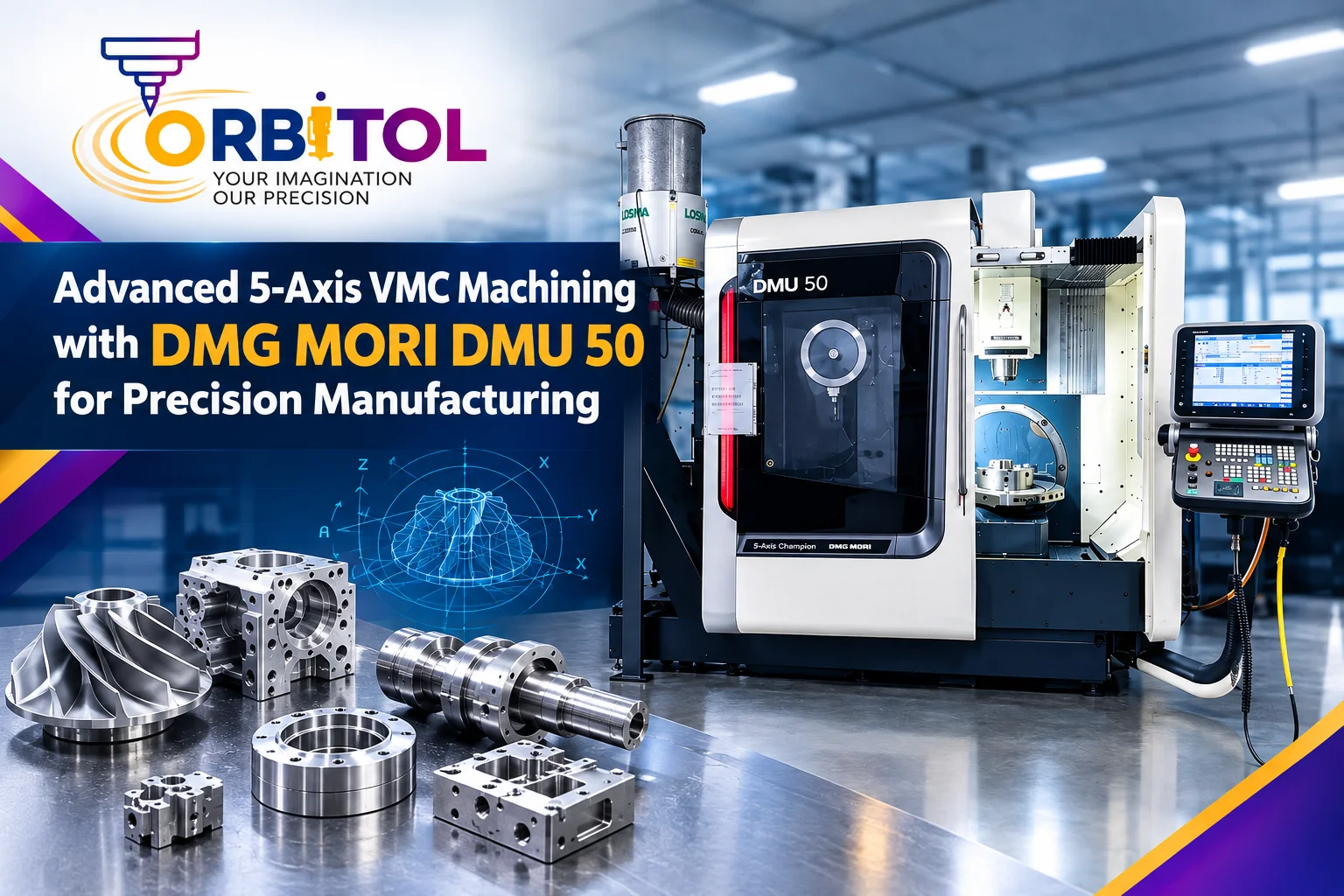
The DMG MORI DMU 50 is a 5-axis universal milling machine. This design uses a unique swivel rotary table allowing multi-directional machining and the possibility to perform simultaneous five-axis operations on the selected parts. The machine configuration allows manufacturers to approach complex Component. From different orientations while maintaining controlled cutting operations.
As stated, the dimensional parameters of the third generation DMU 50 are equal to X=650 mm, Y=520 mm, and Z=475 mm. The maximum Component diameter of the machine is 630 mm as well as maximum height equal to 600 mm and Component. Weight equal to 300 kg. Actual capacity depends on the machine generation, configuration and Components setup.
Swivel rotary table and multi-axis movement
The swivel rotary table is the main component in the design of the DMG MORI DMU 50. By using this component, one can tilt and rotate and get access to different machining surfaces and angles. This flexibility is useful for components with inclined holes, angled faces, complex profiles and features located on multiple sides. The machine rotary movement can help reduce repeated clamping and repositioning. Fewer setups can reduce opportunities for datum transfer errors and help maintain relationships between machined features.
Components with several angled surfaces may require separate positioning operations on a conventional three-axis machine. A suitable five-axis machining strategy can access these surfaces through controlled rotary positioning, depending on the component design and machine configuration.
CNC control and machining flexibility
Five axis machining relies on precise synchronization of movements in a linear and rotary motion. The CNC programming determines the path of the tool, cutting specifications, orientation Component and the order of machining operations.
The DMU 50 is available with different control and software configurations, depending on the model and generation. These systems support the programming and execution of machining operations according to the selected setup and tooling requirements.
DMG MORI India at Orbitol Intelligence, the DMG MORI DMU 50 is relevant to manufacturing applications that require controlled machining of complex industrial geometries. The machining strategy is selected according to the drawing, material, dimensional tolerances and accessibility of the required features.
3. Applications of 5-Axis VMC Machining in Mould, Dies and Precision Parts
Mould and die manufacturing, precision engineering and industrial machinery production frequently involve components with complex profiles and closely related machined features. Five-axis technology supports these requirements when additional tool orientation and access to multiple surfaces are beneficial.
Mould and die component machining
Mould and dies may contain cavities, curved surfaces, angled walls, detailed profiles and accurately positioned mounting features. The quality of these features influences the fit, alignment and functional performance of the finished tooling. 5 Axis VMC Machining allows for the appropriate machining of mold and dies, by letting the cutter access the surfaces from different angles. With that flexibility, it would reduce the number of setups needed for complicated shapes and keep relationships between features that were processed.
In mold making, the proper orientation of the cutting tools matters greatly in order to get to the curved surfaces and achieve proper cavity geometry. The machining operation consists of roughing, semi-finishing, and finishing stages with some machining tools selected according to material of the Component and the surface characteristics.
Automotive and industrial machinery components
Automotive and industrial machinery components often include mounting interfaces, inclined surfaces, complex housings and machined features distributed across multiple faces. These geometries may require several machining orientations to achieve the specified dimensions.
A 5 Axis VMC Machine can help access different faces while reducing repeated Component handling. Components such as specialised housings, brackets, machine parts and precision support components may benefit from this approach when their geometry requires multi-directional machining.
For production work, consistent programming and Component referencing are essential. The same machining strategy must maintain the relationship between critical features while accounting for cutting forces, tool wear and material behavior.
Complex precision components
Precision components used in specialised engineering applications may contain compound angles, contoured surfaces and features that are difficult to machine from a single direction. Five-axis technology provides additional flexibility for producing such geometries.
4. Achieving High Precision Machining with Five-Axis Technology
In the sector of High Precision Machining, one has to control dimensions, the geometry between different components and surfaces. Five-axis technological equipment can provide the firm with a solution of mitigating the number of repetitive setups, and achieving more favorable positioning of the cutting tools, but it does not guarantee the tolerance levels and surface quality.
One has to remember that the accuracy of parts will depend on the level of machine maintenance, programming, type of tooling, stability of the Component, properties of the material and inspection type.
Reducing setup-related positioning errors
Every time a component is removed and repositioned, there is a possibility of introducing alignment or datum transfer errors. When a component requires machining on multiple faces, these errors can affect the relationship between holes, surfaces and profiles.
A five-axis machining system offers a way of controlling the rotation motion; therefore, it can reach various surfaces without requiring the operator to frequently reposition the workpiece. This enhances uniformity in processes if the work is correctly referenced and clamped. This aspect is crucial when machining different angled geometries or complex surfaces.
Tool orientation and surface finish
Tool orientation influences cutting conditions, tool contact and accessibility. In five-axis machining, the tool is angled appropriately against in surface according to the shape of the part and the method of machining employed. In many cases, the quality of the surface depends on many parameters, including cutting speed, rate of feed, geometry of the tool, condition of the tool and the material of Component. Therefore, machining software must take these parameters into consideration. A five-axis machining system offers a way of controlling the rotation motion; therefore, it can reach various surfaces without needing the operator to frequently reposition the Component. This enhances uniformity in processes if the work is correctly referenced and clamped. This aspect is crucial when machining different angled geometries or complex surfaces.
CNC programming and dimensional inspection
Accurate five-axis machining requires reliable CNC programming and verification of tool paths. The program must account for the machine’s rotary configuration, component orientation, tool length and potential interference between the tool, and machine components. Inspection remains an essential part of High Precision Machining. Depending on the engineering drawing, measurements may include dimensional checks, positional accuracy, surface profile and geometric tolerances.
At Orbitol Intelligence, machining requirements should be evaluated according to the component drawing and inspection criteria rather than assuming that every component can achieve the same tolerance.
5. Key Factors in Selecting a 5-Axis VMC Machining Process
Choosing the right machining process requires consideration of the design of the component, the material, tolerances and production goals. A five axis machine is capable of additional movements and its advantages can be used only when the component geometry demands this flexibility.
Component geometry and machining access
The first consideration is the geometry of the component. Angled surfaces, compound profiles, complex cavities and features distributed across several faces may benefit from five-axis machining. The Component dimensions and weight must also fall within the machines permitted working envelope and loading capacity. Tool reach, rotary clearance and Component arrangements should be checked before finalizing the machining plan.
Material, tooling and machining parameters
Material selection plays a big role in terms of forces that are happening during the processing of the object as well as the amount of worn out blades and generated heat or surface texture created. Different materials such as alloys, aluminum and stainless steels will require different approaches during the machining process. Tool selection should rely on materials, requirement for shape and desired surface finish.
Understanding 5 Axis VMC Machine Price
The 5 Axis VMC Machine Price depends on several factors, including machine model, generation, configuration, control system, spindle options, automation and additional equipment. Installation, tooling, software, maintenance and training can also influence the total investment required.
A suitable machine selection begins with a clear understanding of the parts to be manufactured. In order to define if five-axis machines are suitable, one must compare characteristics of machine against the size of the workpiece, its tolerances and type of machining being considered. DMG MORI DMU 50 was developed for the process of general milling and five-axis works but it is recommended to check whether the model has all necessary specifications as well as commercial price.
6. Orbitol Intelligence, Advanced VMC Machining Solutions
Orbitol Intelligence provides precision machining and tool room-related solutions for industrial manufacturing requirements. Its machining capabilities include 5-axis VMC machining, 3-axis VMC machining, Swiss-type machining, mould and die manufacturing and precision component production.
The DMG MORI DMU 50 supports Orbitol five-axis machining applications for suitable complex industrial components. By combining CNC programming, appropriate cutting tools and controlled machining operations, the process is planned according to the component drawing, material and dimensional requirements.
Precision machining for industrial requirements
Different industries require components with different geometries, materials and tolerances. Mould and die components may require accurately machined cavities and profiles, while industrial machinery parts may need precise mounting surfaces, holes and angled features.
At Orbitol Intelligence, the machining process is selected according to the component’s functional requirements and manufacturing specifications. Five-axis machining is particularly relevant when multiple surfaces, complex profiles or angled features require controlled tool access.
Supporting complex component manufacturing
The DMG MORI DMU 50 provides five-axis machining capability for suitable components that require multi-directional cutting and rotary positioning. Combined with suitable CNC programming and process planning, this capability can support the machining of complex geometries while reducing unnecessary components repositioning.
Orbitol Intelligence, for industrial customers, selecting the correct machining approach involves considering part geometry, material, production quantity, tolerance requirements and inspection criteria. Orbitol Intelligence focuses on matching its machining capabilities to these requirements to support precision manufacturing applications.
7. Conclusion
5-Axis VMC Machining has become an important manufacturing process for industrial components that require complex geometries, multiple machining surfaces and controlled dimensional relationships. By combining three linear axes with two rotary axes, a five-axis machine provides greater tool access and machining flexibility than conventional three-axis equipment.
The DMG MORI DMU 50 supports these requirements through its universal milling configuration and swivel rotary table. Its capabilities make it suitable for selected mould and die components, industrial machinery parts and complex precision components, depending on the work piece geometry and machining requirements. Achieving consistent results requires more than advanced machine movement. CNC programming, suitable tooling, stable work holding, appropriate cutting parameters and dimensional inspection all contribute to the final component quality.
At Orbitol Intelligence, five-axis VMC machining forms part of a broader range of precision manufacturing and tool room capabilities. By selecting machining processes according to engineering specifications, Orbitol Intelligence supports industrial applications where dimensional accuracy, surface quality and consistent component production are essential.