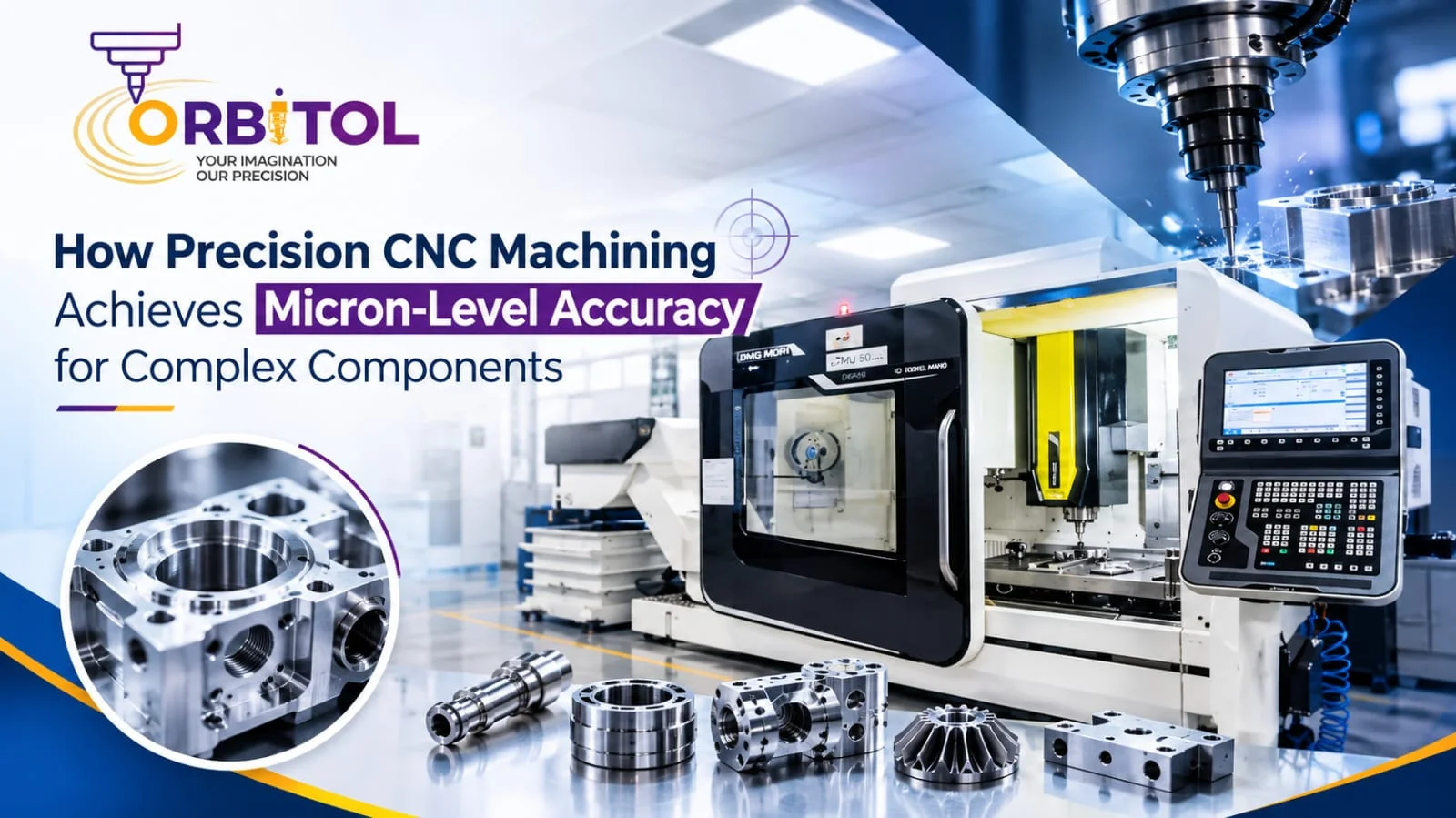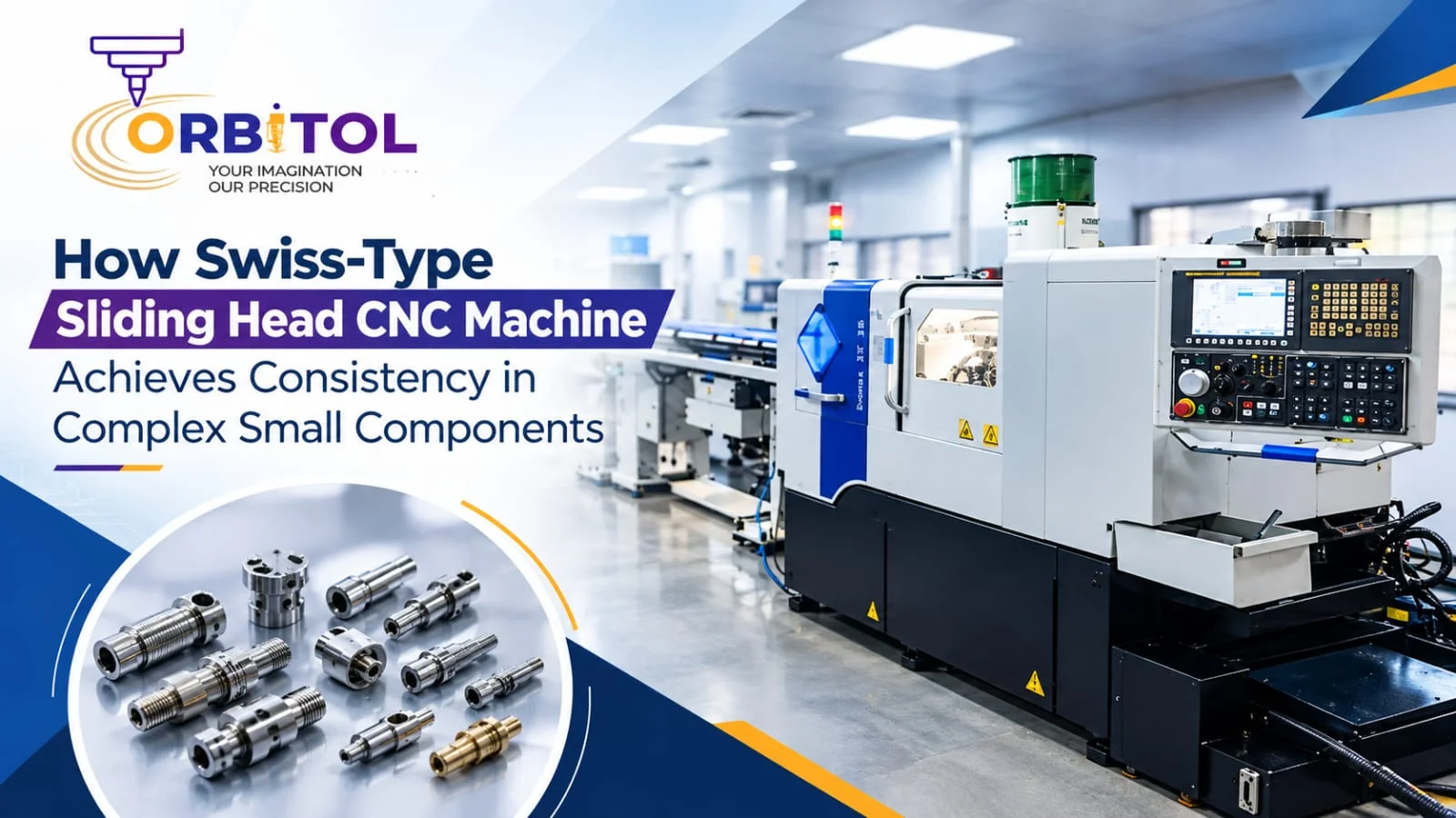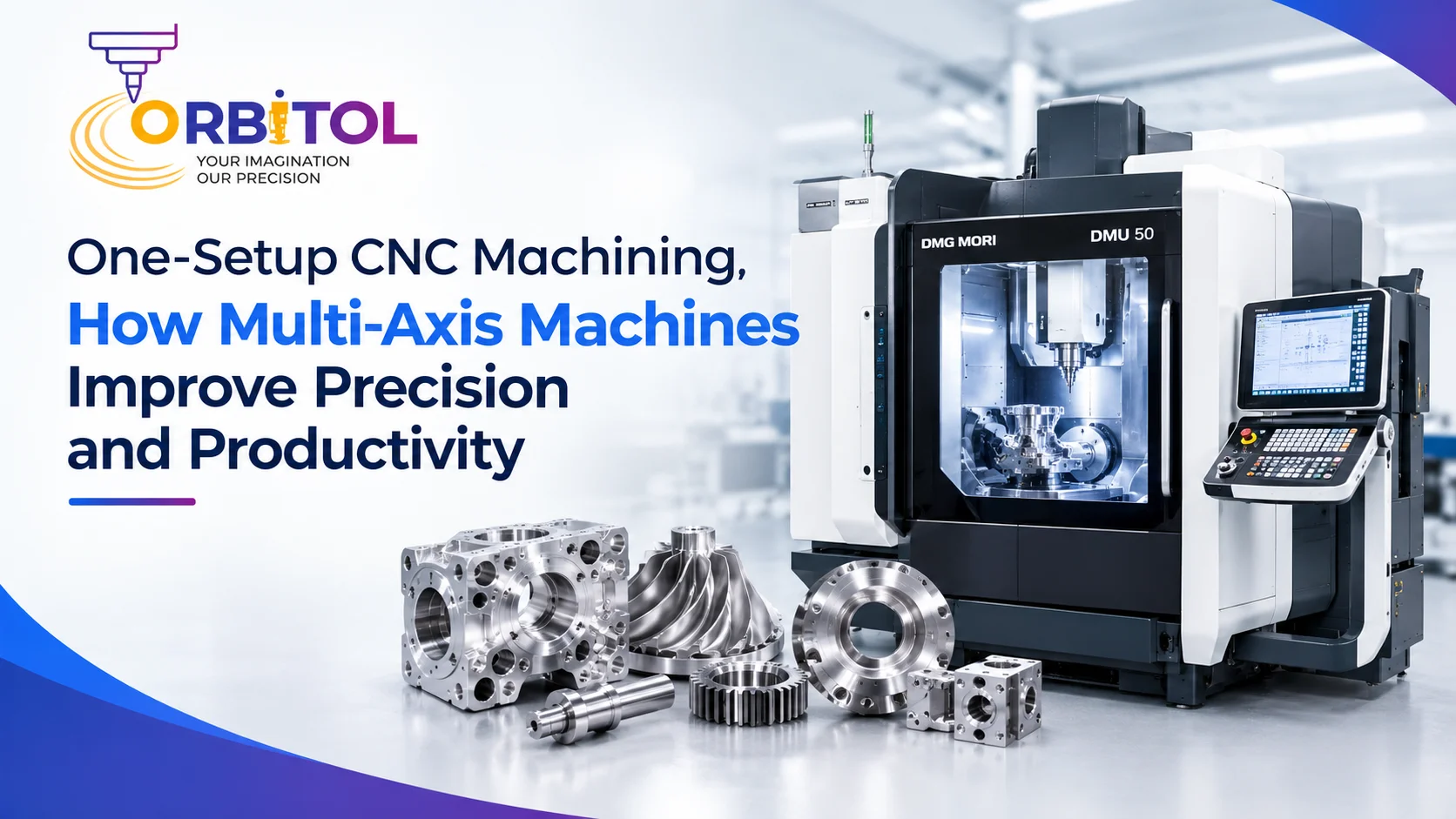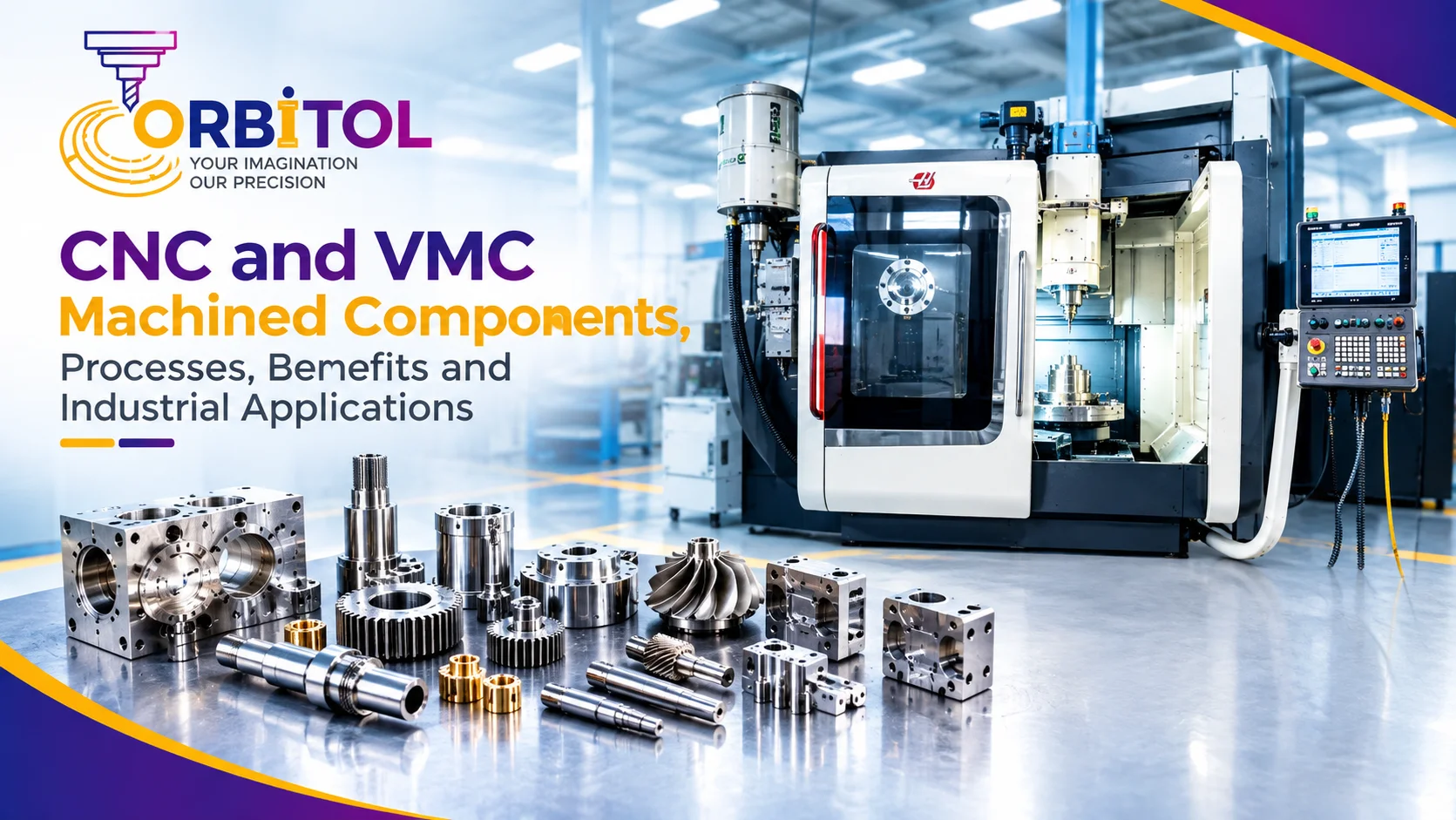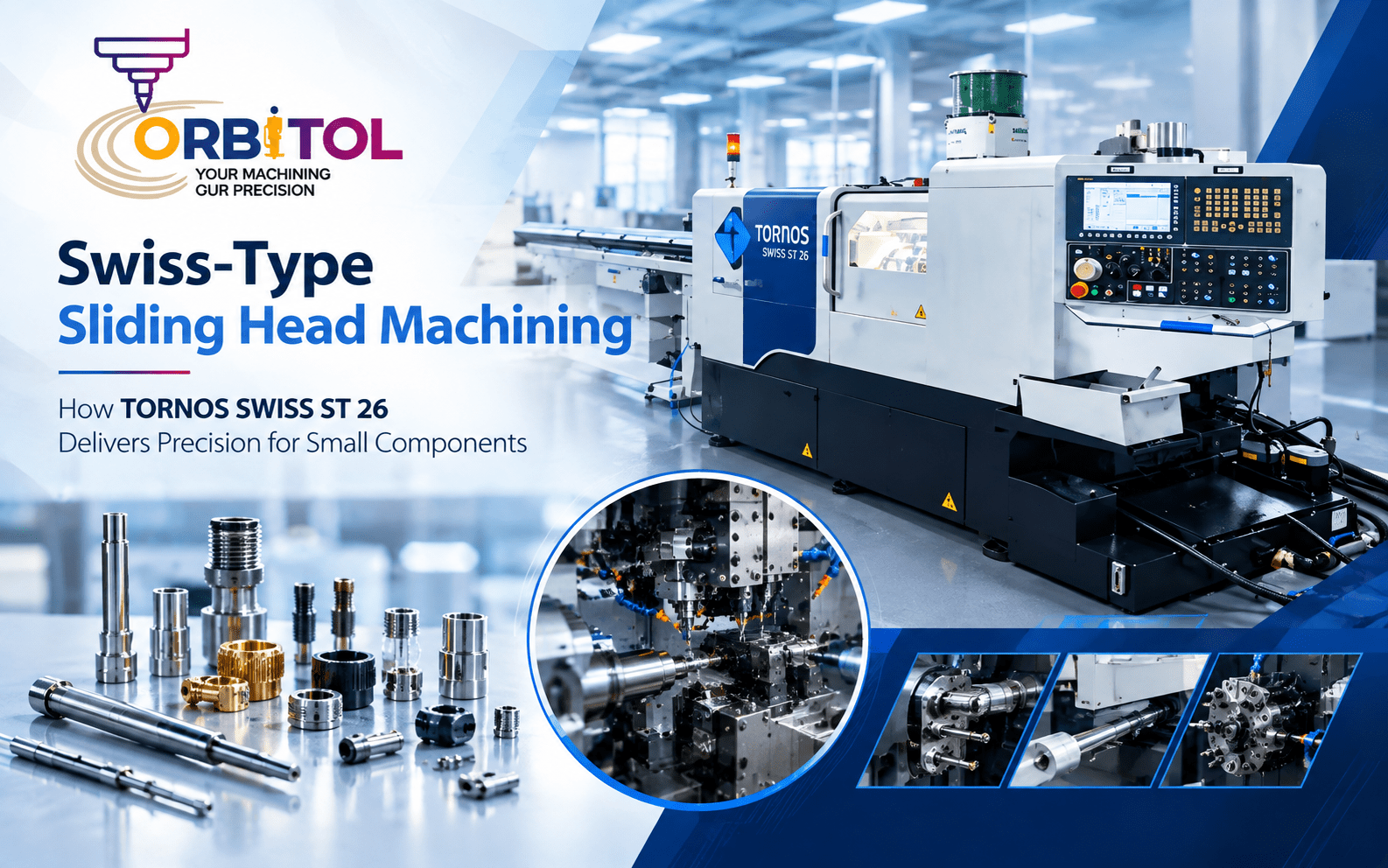
Sliding Head CNC Machine is designed around a different machining principle. from a conventional CNC turning machine. Instead of keeping the work piece fixed at one point. While the cutting tool moves along it, the bar stock can slide through a guide bushing while machining takes place close to the support point.
Table of Contents
1. Introduction to Sliding Head CNC Machine
2. How Swiss-Type Machining Works
3. Why Sliding Head CNC Is Ideal for Small Parts Machining
4. Multi-Axis Machining for Complex Components
5. Role of Tooling, Guide Bushing and CNC Control
6. Achieving High Precision and Consistency
7. Orbitol Intelligence Swiss-Type Machining Capabilities
8. Applications of Swiss-Type Sliding Head Machining
9. Conclusion
1. Introduction to Sliding Head CNC Machine
Making smaller parts can be much more challenging than making larger ones. While a component may only be a millimeter or two across, it may still require a variety of diameters, grooves, threads, cross holes, slots, and other complex forms. And if the dimensional tolerances on these elements are critical. Traditional machining processes may be inadequate to give the desired level of stability and repeatability.
This is where a Sliding Head CNC Machine becomes particularly useful.
This arrangement is especially useful for producing long, slender and small-diameter components.
Modern Swiss-type machines also combine turning with additional machining operations. Allowing manufacturers to produce complicated components with fewer setups.
At Orbitol Intelligence, Swiss-type sliding-head technology is part of a broader precision manufacturing setup. That includes CNC/VMC machining, Swiss-type turning, EDM and other manufacturing processes. The company currently lists both the DMG MORI SPRINT 20/8 and TORNOS SWISS ST 26 among its Swiss-type machining equipment. Orbitol
2. How Swiss-Type Machining Works
The basic principle behind Swiss-Type Machining is relatively simple but highly effective.
In normal turning operations, the work piece is generally placed in a chuck, and the cutting tool takes a pass over the object. The longer the unanchored materials are. The more likely the components will deflect and create vibrations.
Swiss-type machining approaches this problem differently.
The bar material passes through a guide bushing, and the cutting operation takes place close to the point. Where the material is supported. The sliding headstock moves the material along its axis while the tools perform the required cutting operations.
This arrangement provides an important advantage. When machining small-diameter or slender
components.
Reduced Deflection
When a long thin workpiece is manufactured, the cutting forces may cause the element to bend or even start vibrating. Proper positioning of the cutting. Area allows minimizing the unsupported length of the workpiece. This can help improve dimensional stability and machining consistency.
Better Support During Cutting
The guide bushing supports the material close to the cutting zone. This is particularly useful for components where even a small amount of deflection can affect the finished dimensions.
Multiple Operations in One Setup
Modern Swiss-type machines can combine turning. With operations such as milling, drilling and threading.
This means a component can often be completed with fewer separate setups.
Fewer setups can reduce the opportunity for repositioning errors. And help maintain the relationship between different features.
This is one of the key reasons Swiss-Type Machining. Is widely used for demanding Small Parts Machining.
3. Why Sliding Head CNC Is Ideal for Small Parts Machining
Small components often require a combination of accuracy, repeatability and efficient production.
A Sliding Head CNC Machine is particularly suited to this type of work. Because its design provides support close to the machining point.
Consider a small shaft with several stepped diameters and a threaded section. On conventional equipment, the unsupported portion of the shaft can become a concern during machining.
With Swiss-type machining, the material remains supported close to the cutting operation.
This can provide several practical advantages.
Consistent Dimensional Control
Small components frequently contain features with very close dimensional requirements. Maintaining consistent dimensions from the first component to the last is therefore important.
The supported machining arrangement, combined. With CNC control and suitable cutting parameters, helps maintain repeatable production.
Better Control of Slender Components
Long and thin components are particularly sensitive to cutting forces.
Swiss-type machining is designed to handle these geometries by keeping the machining. Zone close to the guide support.
Efficient Batch Production
Once the machining process has been properly programmed and set up. Swiss-type machines can produce repeated components efficiently.
This makes them useful for applications. Where hundreds or thousands of similar small components may be required.
Orbitol lists its DMG MORI SPRINT 20/8 as a Swiss-Type Sliding Head machine. With an 8-axis configuration, 10,000 RPM listed spindle speed, a maximum diameter of 25.4 mm and 5-micron tolerance capability. orbitol
4. Multi-Axis Machining for Complex Components
Small components are not always simple cylindrical parts.
Many precision components include:
– Cross-holes
– Threads
– Grooves
– Flats
– Slots
– Multiple diameters
– Complex profiles
Producing all these features may require several machining operations.
This is where multi-axis capability becomes important.
A modern Sliding Head CNC Machine can use multiple tools. And axis to perform different operations during the same machining cycle.
Instead of removing the component and transferring it to another machine for every secondary operation. Several features can be produced within one controlled setup.
Turning and Milling
The machine can perform turning operations for cylindrical surfaces. While driven tooling can perform milling operations for additional features.
Drilling and Cross-Hole Operations
Small components often require holes positioned perpendicular to the main axis. Multi-axis tooling can allow these features to be machined without completely changing the setup.
Threading
Threads are common in precision fasteners, medical components and small mechanical parts. CNC-controlled threading allows the process to follow programmed dimensions and cutting parameters.
Reduced Repositioning
Every additional setup can introduce a potential alignment variation.
Completing more operations within one setup can therefore help maintain the positional relationship. Between features.
Orbitol TORNOS SWISS ST 26 is listed as a Swiss-type sliding-head machine. With driven tooling and applications including defence, orthopedic and aeronautical components. Orbitol
5. Role of Tooling, Guide Bushing and CNC Control
Achieving consistent results does not depend on the machine alone.
The tooling system, guide bushing, programming and cutting parameters all contribute to the final component.
Guide Bushing
The guide bushing is one of the defining features of Swiss-type machining.
It supports the bar close to the cutting area and helps control movement during machining.
For small-diameter components, this support can be particularly important. because the material can otherwise be more susceptible to deflection.
Precision Tooling
Tool selection also influences machining performance.
Different materials and geometries require suitable cutting tools and machining parameters. Tool wear must also be monitored because a worn tool can affect dimensions and surface quality.
CNC Programming
CNC programming controls the movement of the machine and the sequence of machining operations.
For complex components, accurate programming helps coordinate multiple operations without unnecessary movement or repositioning.
Orbitol lists SolidCAM and Siemens among its CAM and programming technologies for precision manufacturing. Orbitol
Cutting Parameters
Machine performance relies on the spindle speed, feed rate, depth of cut and refrigerant conditions. Properly chosen values for those parameters can ensure optimal machine operation and allow reducing cutting forces. Tool wear, generating heat and ensuring surface properties.
6. Achieving High Precision and Consistency
The main purpose of High Precision Machining is not simply achieving a small tolerance on one component.
The bigger challenge is maintaining that result consistently across an entire production batch.
A precision component may be acceptable. When the first part is measured, but the manufacturing process must also remain stable as more components are produced.
Several factors contribute to this consistency.
Machine Stability
A stable machine structure helps minimize unwanted movement and vibration during cutting.
Tool Condition
Cutting tools gradually wear. Monitoring tool condition helps prevent dimensional changes during production.
Material Control
Different materials behave differently during machining. Stainless steel, titanium, brass and other alloys can require different machining strategies.
Process Monitoring
Checking dimensions during production can help identify changes. Before they result in a larger batch of non-conforming parts.
Final Inspection
Finished components can be checked against their required dimensions and specifications before being released.
Orbitol states that its Swiss-type manufacturing capabilities are designed around high-precision component production. With the SPRINT 20/8 listed at 5-micron tolerance capability and the broader facility incorporating inspection and quality-control processes. Orbitol
7. Orbitol Intelligence Swiss-Type Machining Capabilities
At Orbitol Intelligence, Swiss-type machining is part of a wider precision manufacturing ecosystem.
The company’s current machine-capability information lists two dedicated Swiss-type sliding-head machines:
DMG MORI SPRINT 20/8
The DMG MORI SPRINT 20/8 is listed as a Swiss-Type Sliding Head machine with
– 10,000 RPM listed spindle speed
– Maximum diameter of 25.4 mm
– Fanuc Series 31iA controller
– 2-metre stroke length
– 5-micron tolerance capability
– Applications including watch components, medical screws and aerospace pins Orbitol
These capabilities make it suitable for small-diameter components requiring controlled. Turning and multi-operation machining.
TORNOS SWISS ST 26
The TORNOS SWISS ST 26 is another important machine in Orbitol Swiss-type machining setup.
Orbitol lists the machine with a 25.4 mm diameter range, 10,000 RPM listed spindle speed. Fanuc control, 9 axes and applications including defence. Orthopedic and aeronautical components. The company also lists in-process quality-control methods including laser and camera inspection for this machine.
Together, these machines give Orbitol Intelligence the ability to handle. Different requirements for small and complex components.
The company’s overall manufacturing capability also includes 3-axis and 5-axis CNC/VMC machining. EDM, grinding and other precision processes. Orbitol
This allows the machining process to be selected according to component. Geometry, material, tolerance and production requirements.
8. Applications of Swiss-Type Sliding Head Machining
The demand for Small Parts Machining continues across industries. Where components must be compact, repeatable and dimensionally controlled.
Medical Components
Small medical components can require complex profiles and close dimensional control.
Orbitol lists medical screws and orthopedic implant-related components. Among the applications associated with its Swiss-type machining capabilities.
Aerospace Components
Aerospace applications can include small pins. Precision fasteners and other engineered components where dimensional consistency is important.
Orbitol lists aerospace pins and aeronautical applications for its Swiss-type machines.
Watch and Precision Components
Miniature components used in watches and precision mechanisms can require accurate diameters. Small features and consistent repeatability.
The SPRINT 20/8 is specifically listed by Orbitol for watch components. orbitol
Precision Fasteners
Small fasteners often contain threads, multiple diameters and other detailed features. A Swiss-type process can combine several operations while maintaining controlled positioning.
These examples demonstrate why a Swiss lathe is more than simply a smaller version of a conventional turning machine. Its guide-bushing architecture, sliding-head movement and multi-axis capabilities. Are specifically suited to demanding small-component production.
9. Conclusion
A Sliding Head CNC Machine achieves consistency in complex small components. By combining controlled material support, CNC programming, precision tooling and multi-axis machining.
The guide-bushing system keeps the material supported close to the cutting zone, helping reduce deflection when machining small or slender components. Multi-axis tooling can then perform turning, drilling, milling and threading operations within a coordinated machining process.
This makes Swiss-Type Machining particularly suitable for Small Parts Machining. Where dimensional accuracy and repeatability are critical.
For Complex Components, reducing unnecessary setups can also help maintain the positional relationship between different features. Combined with suitable tooling, machine control and inspection, this creates a controlled. Manufacturing process for demanding applications.
At Orbitol Intelligence, the DMG MORI SPRINT 20/8 and TORNOS SWISS ST 26 provide dedicated Swiss-type machining capabilities for small and precision components. Orbitol broader manufacturing setup also includes 3-axis and 5-axis CNC/VMC machining, allowing different component requirements to be matched with appropriate machining technology.
When small components require High Precision Machining, consistency comes from more than just a CNC machine. It comes from the complete process from material support and tooling to programming, machining and inspection.
For manufacturers looking for reliable Swiss-Type Machining of small, detailed and precision-critical components. The right machine configuration and controlled production process can make a significant difference.