5-Axis VMC Machine, In all areas including automotive, aerospace, medical, tooling, and industry, complex components are increasingly applied to industries. Manufacturers require machining processes that ensure accuracy as component shapes become complex in nature. The factors responsible for this also rely on the increased need for flexible machining techniques to take care of the tightened tolerances and complicated shapes.
5-Axis VMC Machine is a solution to the aforementioned problem. This machine makes it available for the cutting tool to reach the element from a variety of different angles. This means that manufacturers can minimize setups. While improving access to the already existing areas and perform complex tasks more easily.
When working with Complex Precision Components. 5-Axis Machining will give the manufacturers the most flexible options but still keep the process under control.
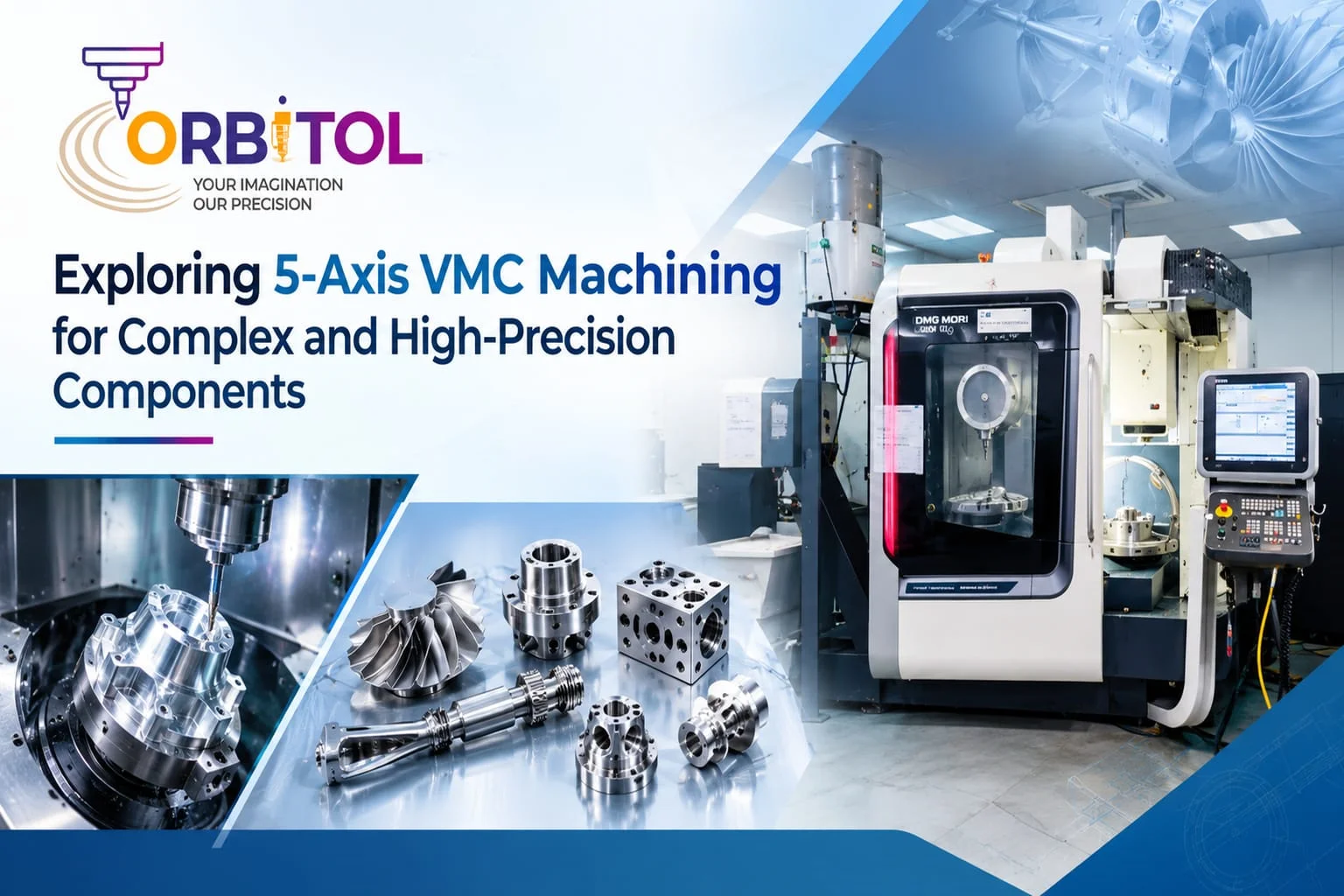
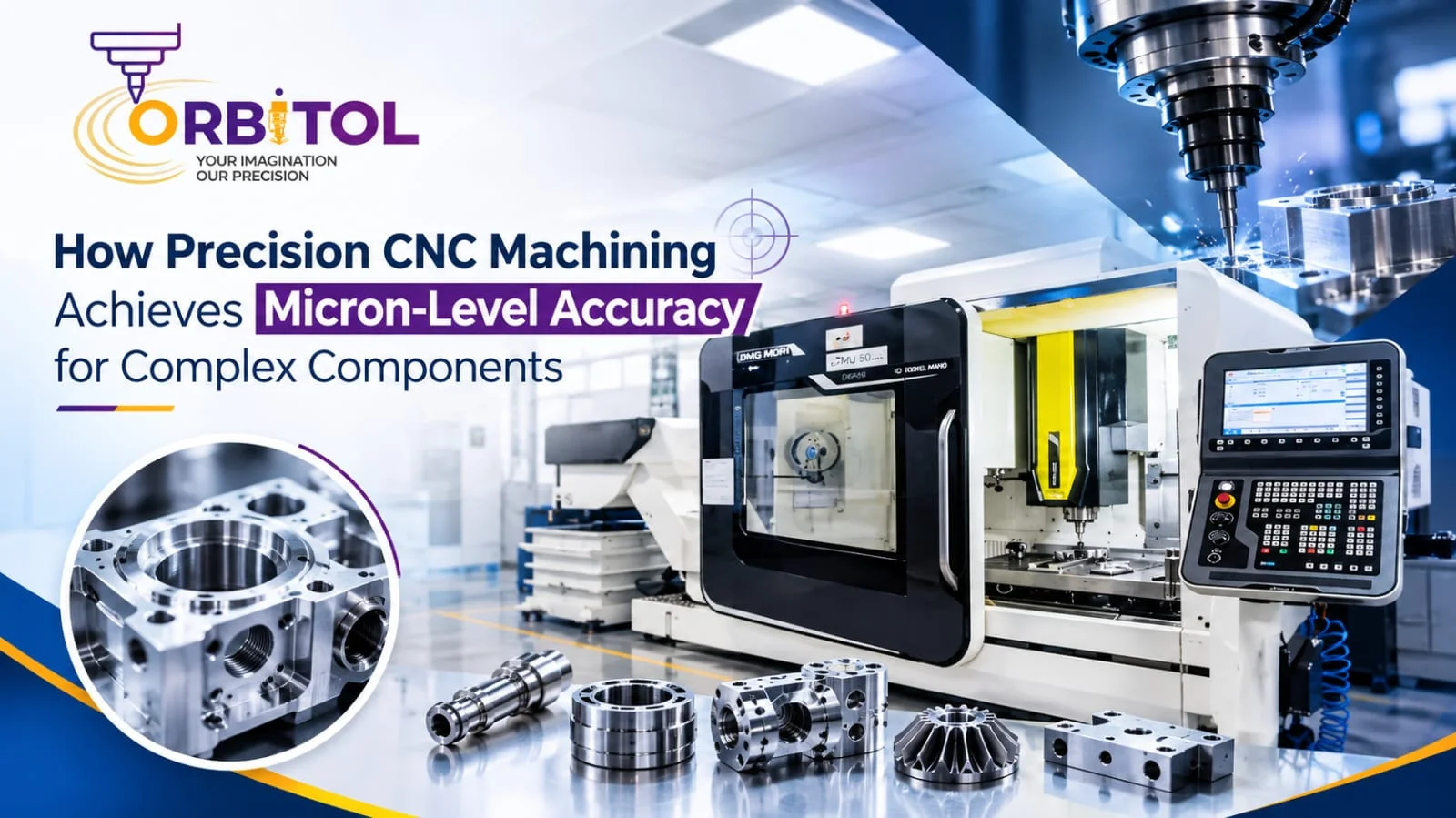
Orbitol Intelligence uses a DMG MORI DMU 50 for 5-Axis CNC Machining. Supporting the production of complex and high-precision components.
Table of Contents
1. What Makes 5-Axis VMC Machining Different?
2. How 5-Axis Machining Helps Produce Complex Components
3. The Role of 5-Axis VMC in High Precision Machining
4. Applications of Precision Machined Components
5. Why Choose Orbitol Intelligence for 5-Axis VMC Machining?
6. From Programming to Finished Component
7. Conclusion
1. What Makes 5-Axis VMC Machining Different?
A regular 3-axis operation moves the cutting tool along three linear axes: X, Y, and Z. In contrast, a VMC Machine 5 Axis adds two rotary movements to these three linear movements. This arrangement allows the cutting tool and workpiece to take different orientations during machining.
The major advantage is improved access to multiple surfaces of a component. For certain complex parts, conventional machining may require several setups. In each setup, the operator must remove, reposition, and realign the component before machining additional features. Every additional setup can introduce alignment variation.
However, a 5-axis process can reduce this requirement because the machine can reach multiple features in fewer setups. Consequently, manufacturers can improve flexibility and maintain better consistency between related features.
Key advantages include
- Multi-surface machining
- Better access to angled features
- Reduced setup requirements
- Improved machining flexibility
- Better consistency between related features
- Efficient production of complex geometries
2. How 5-Axis Machining Helps Produce Complex Components
One of the primary benefits of 5-axis machining is that it allows for complex geometric shapes in a given component. Various features, inclining surfaces, undercuts, pockets, and shapes. With different orientations can be included in a component with 5-axis machining.
Machining these features with a conventional setup can require multiple operations. With 5-axis machining, the cutting tool can orient itself toward the required surface. While the machining system controls the movement of the tool and workpiece. Therefore. The process can provide better access to complex areas.
Reduced Number of Setups
One of the biggest benefits of 5-axis machining is the possibility of machining several features in fewer setups. Fewer setups can reduce the chances of repositioning errors.
For example, when several surfaces need to maintain a precise relationship. With one another, machining them within the same setup can help maintain their positional relationship. This approach is particularly useful for complex Precision Components. Where dimensional and geometric consistency are important.
Better Tool Axes
Tool accessibility can become a major challenge. When manufacturers machine complicated shapes. A fixed tool orientation may not reach certain areas efficiently.
The basic idea lies in the fact that having rotational axes provides the possibility for the machine to adjust the position of the tool. As a result, the machine can operate with the most complex shapes.
Complex Profiles and Angled Features
5-axis machining is well suited to components containing. Compound angles, contoured surfaces, deep cavities, angled holes, undercuts, and complex profiles.
Furthermore, the ability to change tool orientation can make the machining process more efficient. For these types of components.
3. The Role of 5-Axis VMC in High Precision Machining
Precision does not depend on the machine alone. However, machine capability plays an important role in maintaining dimensional and geometric control.
For effective High Precision Machining, proper machine equipment, programming, holding techniques, and parameters must be used. A 5-axis machining center will eliminate excess setups and provide access to difficult surfaces.
Maintaining Component Relationships
Consider a component with several surfaces that must maintain a precise relationship. With each other. If manufacturers machine these surfaces through multiple setups. They must accurately reposition the component each time.
With suitable 5-axis machining strategies, several features can be produced within a single setup. As a result, manufacturers can better maintain the relationship between critical features.
Better Surface Machining
The machines tool position plays a crucial role. Unlike conventional machines. Where the tool position is fixed, the advanced machine will allow the tool to be positioned according to the parameters of the geometric shape.
This, using this solution improves machining productivity and quality of surfaces formed by the workpiece surfaces.
Controlled Production
For production components, repeatability is equally important. A properly developed CNC program can be reused for subsequent components. Allowing the machining process to follow the same programmed movements.
Therefore, 5-axis technology is useful for producing Precision Machined Components. Where consistency from part to part matters.
4. Applications of Precision Machined Components
The ability to machine complex geometries makes 5-axis technology relevant across several industrial applications.
Automotive Components
Vehicle components often include complex geometries, such as complicated pockets and sophisticated surfaces. A 5-Axis VMC Machine can help manufacture such components. When multiple surfaces require precise machining.
Moreover, fewer setup requirements can be beneficial when several components or features need a particular orientation relative to one another.
Aerospace Components
Aerospace components can contain complex contours and difficult-to-machine geometries. 5-axis machining allows the cutting tool to approach surfaces from different orientations, making it suitable for components where accessibility is important.
In addition, the technology can support efficient machining of contoured surfaces and compound features.
Mould and Die
Mould and die manufacturing is another important application. Mould cavities and die surfaces often contain complex curves, deep areas, and intricate geometries.
Using a 5-axis machining strategy can provide better tool access to these surfaces while reducing the need for repeated repositioning. For tool-room applications, this capability can be particularly valuable when dimensional consistency and surface quality are important.
Medical Components
Medical manufacturing may involve small and intricate components that require controlled dimensions and complex geometries. Depending on the component design, 5-axis machining can provide the tool access required to machine multiple surfaces accurately.
Industrial Precision Components
Industrial machinery also uses components with complex profiles, mounting surfaces, and functional features. The flexibility of a 5-axis system makes it suitable for manufacturing different types of VMC Machining Parts, particularly when conventional machining would require multiple setups.
5. Why Choose Orbitol Intelligence for 5-Axis VMC Machining?
At Orbitol Intelligence, 5-axis machining is supported by the DMG MORI DMU 50, a machining center designed for complex component manufacturing. The machine provides simultaneous multi-axis machining capability, allowing components to be approached from different tool orientations.
This capability makes the machine suitable for manufacturing components involving complex profiles, angled surfaces, compound features, undercuts, and multiple machined surfaces.
Orbitol Intelligence combines 5-axis VMC machining with other precision manufacturing capabilities. This approach allows machining requirements to be selected according to component geometry and production needs.
The company’s manufacturing capabilities also include 3-axis VMC machining, Swiss-type machining, CNC turning, EDM, and other precision manufacturing processes. This range is important because not every component requires the same machining strategy.
For example, manufacturers can efficiently produce a straightforward component using 3-axis machining, while a component with multiple angled surfaces or complex geometry may benefit from a VMC Machine 5 Axis approach.
6. From Programming to Finished Component
An effective high-precision machining operation involves more than just the use of an appropriate machine tool. Rather, the process starts with an understanding of the design of the components and recognizing the features of the components that necessitate controlled machining.
Subsequent to understanding the component design, process planners formulate the toolpath based on the component geometry, material, and machining specifications. The factors such as workholding, cutting tools, tool parameters, and machine orientation all have a role to play in the final outcome.
Quality inspection takes place after machining. Microscopy and measuring devices are used to verify if parts meet specifications.
Overall, this complete process helps transform a digital component design into accurate Precision Machined Components.
7. Conclusion
The growing complexity of industrial components has increased the need for flexible and accurate machining technologies. 5-Axis VMC machine represents an invaluable benefit as it enables the cutting tool to approach a part from various perspectives. Due to this, manufacturers minimize the need for setups, enhance the accessibility of tools, and make it possible to machine the complex surfaces. In high precision machining, this becomes especially advantageous when machining parts having compound angles, curvature, profundity, undercuts, or numerous critical features.
5-axis machining may be used for machining automotive and aerospace parts, moulds and dies, and other types of industrial precision components.
At Orbitol Intelligence, the DMG MORI DMU 50 supports 5-axis VMC machining for complex component manufacturing. Combined with the company’s broader CNC, VMC, Swiss-type, and precision manufacturing capabilities, this allows machining processes to be selected according to the actual requirements of the component.
In the end, the success of 5-axis machining does not hinge solely on the extra axes available, but rather on how well the machine, the programming. The tooling, the workholding and the inspection work together in order to produce repeatable and accurate results. For complicated parts made by the vertical machining center, the correct application of 5-axis machining can transform difficult shapes into a device that can be manufactured with great precision.manufactured components.