Introduction
Nowadays factories care most about hitting exact marks fast, every time. Not cars alone but spaceships too rely on gear that repeats moves without fail. Enter stage left: machines shaped by coded commands instead of hands – cnc milling plus lathes step up here. These tools live inside the big family called computer numerical control, although how they cut varies widely in approach, hardware used, and jobs taken. Machines spin one way while others slide tools across surfaces differently.
Starting out in machining? You might wonder about CNC machining – especially the difference between milling and turning. Though automation drives them both, along with precise engineering and software like CAD CAM, picking one affects costs, output speed, and product quality.
Picture a machine shaping metal bit by bit. That one dives into how cnc milling works, step after step. Next comes spinning material while tools cut – welcome to cnc turning. Each stage gets spelled out without skipping details. One follows the other until both processes stand face to face. Differences show up plainly once side by side. Knowing them helps match method to job. Picking who handles the work shifts outcomes more than expected.
What is CNC Machining?
Understanding CNC machining comes first, yet that step often gets skipped when diving into differences between milling and turning. Only then does sorting out their roles make sense.
From a digital blueprint, machinery moves exactly as coded – no human hands guiding it. That’s what CNC means: computer numerical control, where instructions replace guesswork. Machines follow paths set by software, again and again without drift. Precision locks in because the system repeats motions identically each time. Efficiency comes from speed, consistency, never tiring.
Key features of cnc machining include:
- Automated tool movement based on digital instructions
- Integration with CAD CAM systems
- Exactly right most of the time because mistakes happen less when people step back. Precision grows where hands stay off
- Ability to handle complex shapes and tight tolerances
From a block of stuff – metal, maybe plastic or composite – it gets carved into shape using sharp spinning tools. One way slices around the outside; that one people call turning. Another moves across faces, taking layers off step by step – that’s milling. How the tool dances tells which type it is.
What is CNC Milling?
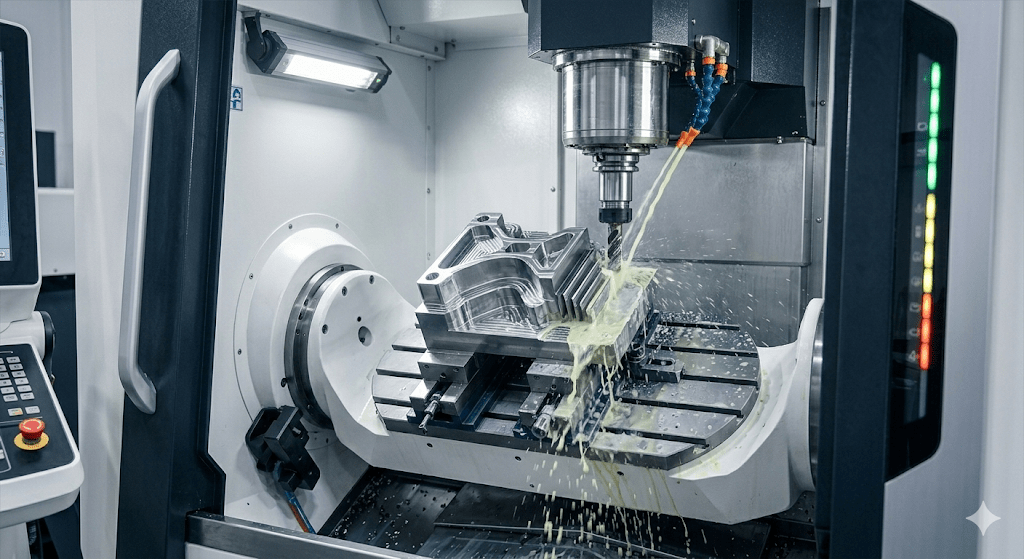
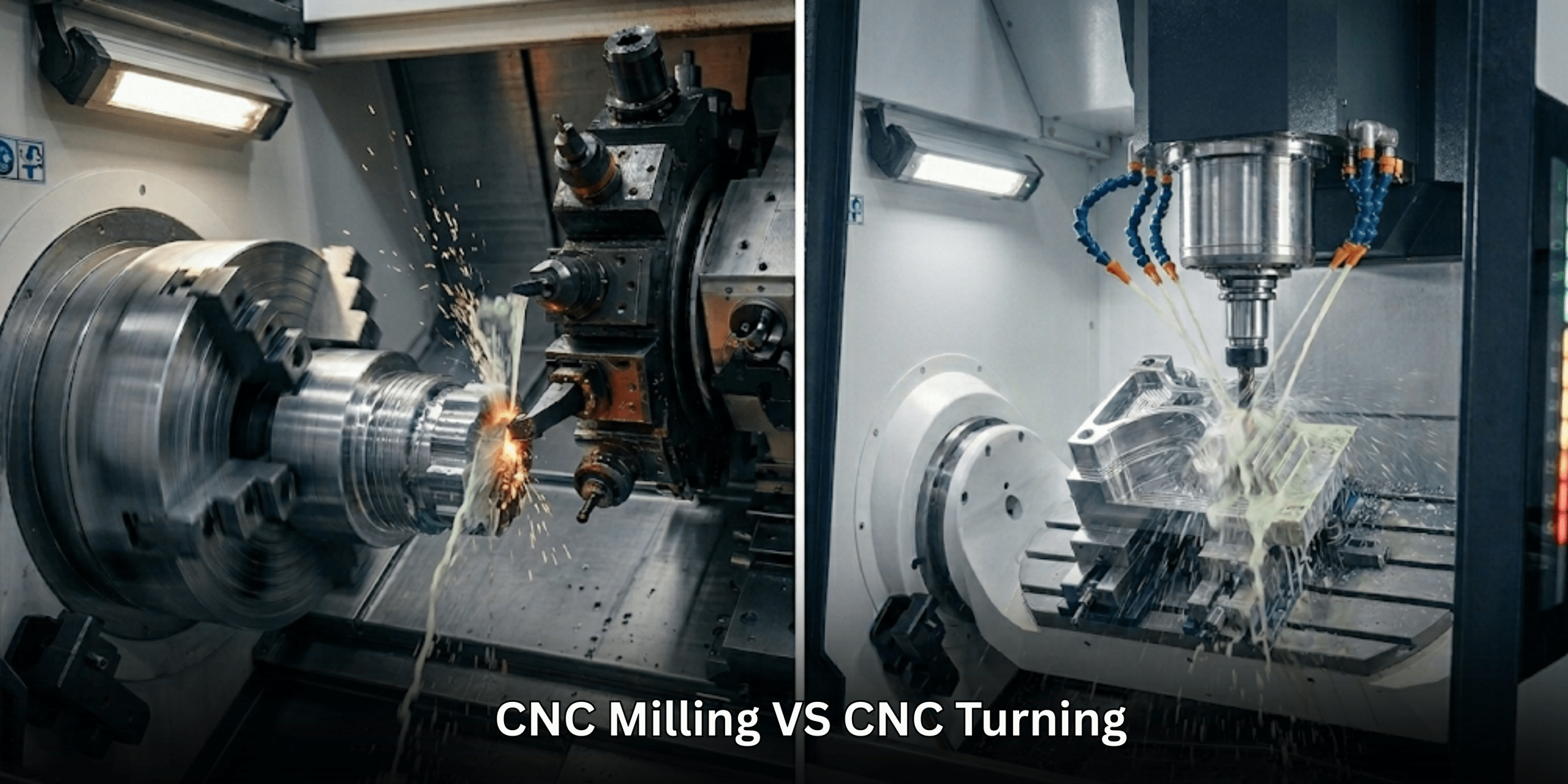
Starting off, CNC milling ranks among the top choices in computer-controlled machining. A spinning cutter with many edges takes away material from a fixed part. Movement across several directions lets it craft intricate forms and sharp features. Complexity comes naturally thanks to its multidirectional capability.
CNC milling is ideal when parts require:
- Flat surfaces
- Slots and pockets
- Contours and complex geometries
- Precise hole patterns
CNC Milling works differently than turning. The piece being shaped stays still while a fast-spinning tool removes bits of it step by step.
Features of CNC Milling
- Uses multi-point cutting tools
- Workpiece remains fixed
- Shapes that are tricky or uneven fit just fine. Irregular forms work well here too. Complex designs find their place without issue. Odd contours handle smoothly through this process
- Fine on metal, also sticks to plastic – handles alloys too without fuss
From cars to planes, cnc milling shows up everywhere – factories rely on it because it adapts fast. Electronics makers use it just as much as those building heavy tools. Wherever precision matters, this method fits right in. Even complex parts take shape easily, thanks to how smoothly it handles different tasks.
CNC Milling Process
A single misstep can throw off the whole job – so precision matters from the start. Picture this: a block of material slowly shaped by spinning tools, guided step by step. One wrong move early on echoes through every cut that follows. Each stage links tightly to the next, like gears turning in sequence. Mistakes pile up fast if attention slips even slightly. Smooth progress depends on careful planning before any machine powers on.
Step 1 – CAD CAM Design
In CNC Milling, a single idea kicks off inside CAD CAM tools. From there, a designer builds the piece on screen through Computer-Aided Design. Next step? Those visuals shift into coded commands via Computer-Aided Manufacturing. Instructions ready, machines take over.
Step 2 – Material Setup
Held tight on the worktable, the raw piece stays fixed in place. Only when lined up just right will the cuts stay true during milling.
Step 3 – Choosing Tools
Not every cutter works the same way. End mills shape edges, while face mills flatten surfaces instead. Ball nose models handle curved areas differently. Purpose guides choice here. A flat edge won’t do what a rounded tip can.
Step 4 – Machining Process
A spinning cutter chips away at raw stock, guided by coded directions across three dimensions. Movement happens left to right, front to back, up and down, step by careful step.
Step 5 – Final Check and Touch Up
Once milling finishes, workers check each part’s precision. When needed, extra smoothing steps follow afterward.
A single tool shapes metal slowly when fine features take priority over fast production. What matters most shows up in tight corners and deep pockets few methods reach.
What is CNC Turning?
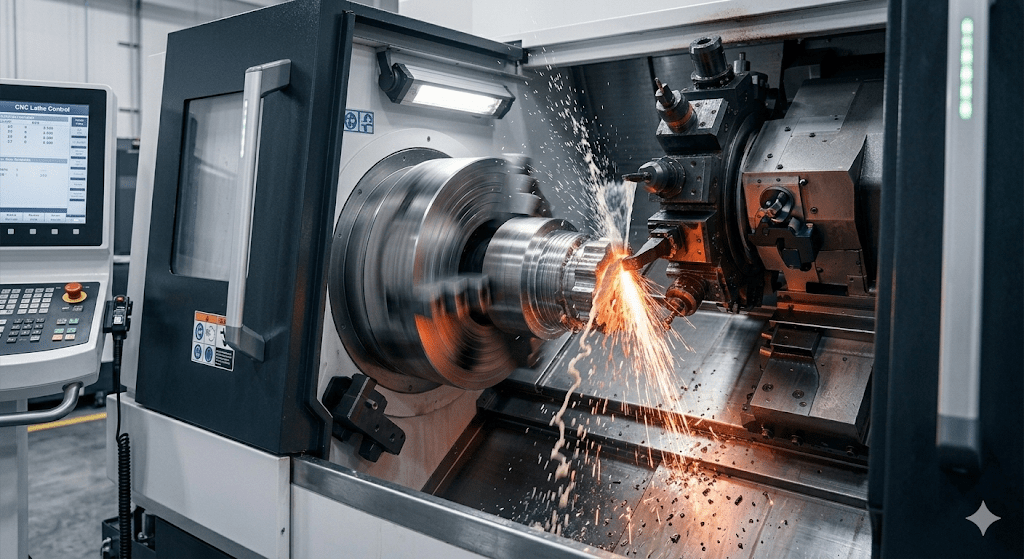
A spinning part meets a steady cutter in CNC turning – one key method beside milling. Rotation does the job here, different from how mills chip away at things. The tool stays put as the object moves, shaving off bits slowly. Instead of multiple edges biting in, just one edge takes turns slicing. This way shapes form through circular motion, not back and forth travel.
Spinning metal parts usually happens using computer-run lathes, best suited when shapes are round. While some methods work differently, this one shines where cylinders are needed.
Typical products made using cnc turning include:
- Shafts
- Bushings
- Pins
- Threaded components
Spinning nonstop makes CNC turning a fast way to build balanced shapes. While rotation runs constantly, shaping parts stays smooth and steady.
Features of CNC Turning
- Uses a single point cutting tool
- Workpiece rotates at high speed
- Perfect when dealing with circular or tube shaped components
- Faster cycle times for mass production
When steady results matter most, CNC turning usually fits the bill – especially if volume counts. Output stays even, run after run, thanks to its precision-built rhythm.
CNC Turning Process
A single tool shapes the material while the machine spins it fast. Speed meets precision without extra steps getting in the way. Each movement stays tight, controlled by programmed paths that repeat flawlessly. Mistakes fade when rhythm and timing lock into place. The part takes form under steady hands guided by code.
Step 1 – CAD CAM Programming
A computer draws the shape first, just like in milling. After that, software turns the drawing into machine steps.
Step 2 – Material Loading
A chunk of metal gets clamped into the spinning grip of a machine. Held tight, it turns steadily while being shaped.
Step 3 – Tool Placement
The workpiece spins while a lone cutting edge presses into it. Position matters when one sharp tip meets turning metal. Spinning material runs toward a fixed blade. Rotation brings the surface close to an unmoving cutter. A solitary tool touches round stock in motion.
Step 4 – Material Removed
Spinning the workpiece lets the cutter glide straight, peeling away bits until the form fits. Shape emerges as metal yields under steady motion.
Step 5 – Final Check
After spinning stops, a worker checks size first thing. Precision matters next, so they look closely at smoothness too. Only when both match specs does it pass. Final call comes down after comparing numbers.
A single cut shapes metal fast when machines run nonstop. Big batches come together smoothly thanks to steady rotation and precision tools.
Difference Between CNC Milling and CNC Turning
What really matters next is how CNC milling compares to CNC turning.
Even though they’re both types of cnc machining, how they operate sets them apart in key ways. Their tools behave differently depending on the task at hand. One might spin fast while the other moves slowly across material. Applications shift based on precision needs and part geometry. What works for one won’t always suit the other. Differences become clear once you watch each machine run.
Key Functional Differences
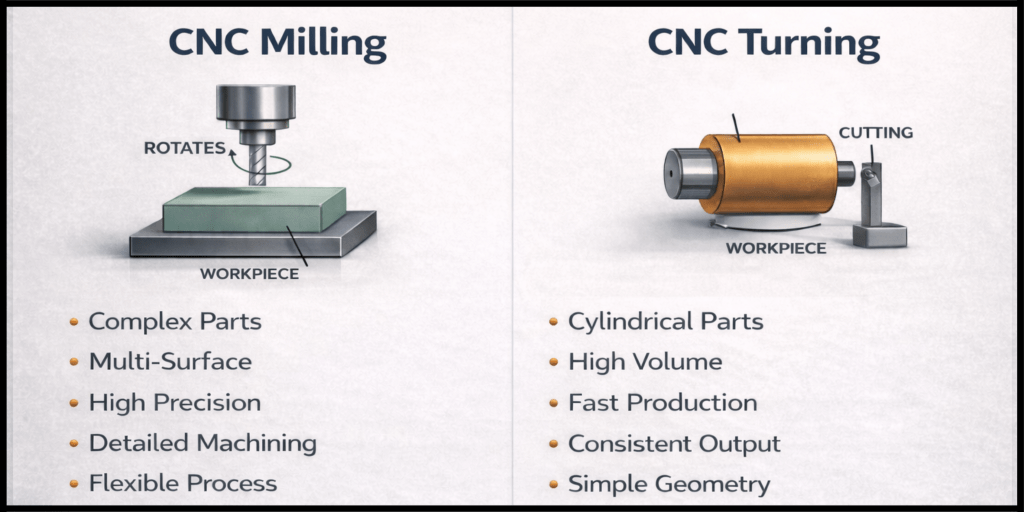
- CNC milling uses rotating cutting tools on a stationary workpiece
- CNC turning uses a rotating workpiece with a stationary cutting tool
- CNC milling handles complex shapes better
- In Spinning metal parts , CNC turning really shows its strength
Shape of the piece matters most when picking cnc milling or cnc turning. While how many you need can tilt the choice one way. Precision needs might steer things differently though.
Table of Key Differences: CNC Milling vs CNC Turning
| Feature | CNC Milling | CNC Turning |
| Cutting Tool | Multi-point cutting tool | Single point cutting tool |
| Workpiece Movement | Stationary | Rotates |
| Tool Movement | Multi-axis (X, Y, Z) | Linear |
| Ideal Shapes | Complex, flat, irregular | Cylindrical, round |
| Production Speed | Moderate | High |
| Surface Finish | Very fine | Extremely smooth |
| Complexity Handling | High | Medium |
| Cost Efficiency | Better for complex parts | Better for mass production |
Choosing Between CNC Milling and CNC Turning
Choose CNC Milling When:
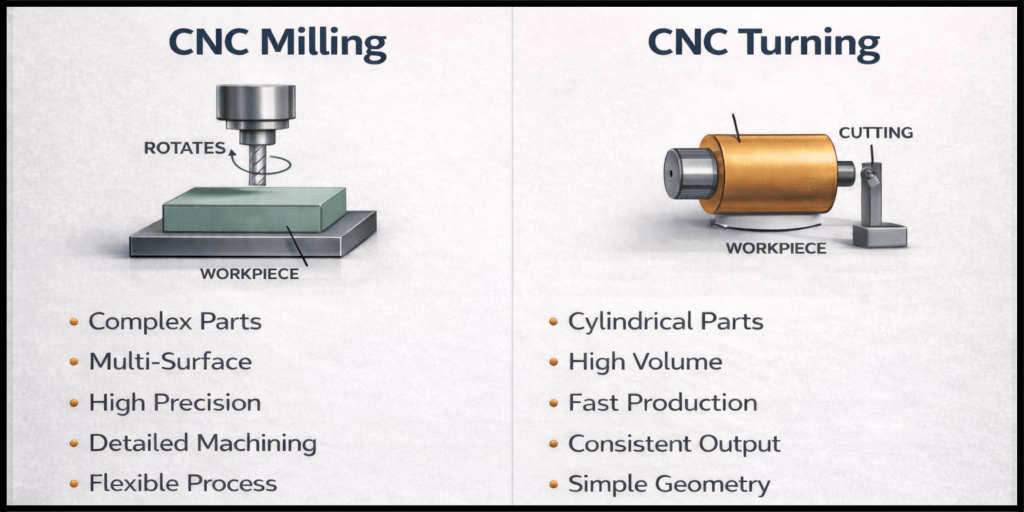
- Need precise metal shaping with rotating cutting tools
- Parts have complex geometries
- Multiple surfaces need machining
- High precision detailing is required
- Flexibility is more important than speed
Choose CNC Turning For Precision Metal Parts
- Parts are cylindrical or round
- High-volume production is needed
- Speed and consistency matter
- Simple geometries are involved
- Knowing how they differ helps pick the right cnc process without wasting money or time.
Why Choose Orbitol for CNC Machining?
A good fit in manufacturing matters – especially when precision parts need cnc milling or cnc turning. The way a shop handles your job can weigh heavier than the method picked.
What stands behind Orbitol Intelligence Pvt Ltd is precision engineering shaped by today’s factory demands. Machines respond smarter, faster, because design follows real function. Custom work isn’t an add-on – it builds into every step. Industry moves on reliability, so systems adapt before conditions shift. Performance stays sharp through constant feedback loops. Not just parts are made – capabilities grow alongside them.
What Makes Orbitol Stand Out?
- Advanced CNC milling and CNC turning capabilities
- Expert engineers skilled in CAD CAM programming
- High-precision machines with strict quality control
- From roads to factories, tailored systems fit unique needs. Machines work better when designs match real tasks. Each project shapes its own path forward
- Reliable delivery timelines and competitive pricing
Every detail matters when it comes to Orbitol. Precision leads the way, followed closely by speed that doesn’t sacrifice results. When tasks demand intricate shapes carved by cnc milling, capability holds firm. High-output runs shaped through cnc turning? Reliability stays steady throughout. Through each phase, one thing remains unchanged – quality never slips.
Conclusion
One way machines shape metal is through cnc milling, another is cnc turning – both sit at the core of today’s manufacturing. Where cnc milling handles detailed shapes well, spinning tools on a lathe finish round pieces faster. Knowing what cnc machining means, plus seeing how cutting paths differ between milling and rotating stock, helps shops choose wisely. Though each method cuts material, their motion patterns lead to different results.
A single solution never works for every CNC need. Depending on the part’s shape, how many you need, precision levels, plus where it will be used, the best method shifts. Working alongside a skilled team such as Orbitol opens paths to blend milling with turning, matching each job to its ideal process.
Achieving accuracy, consistency, and growth in production isn’t just about machines – it hinges on choosing a capable CNC method along with skilled support behind it. What matters most shows up when demands rise; performance stays steady because the foundation was built wisely from the start.