Introduction to CNC and VMC Machining in Automotive Manufacturing
The automotive industry is one of the most advanced manufacturing sectors in the world. Every vehicle is made up of thousands of automotive components that must work together impeccably. These automotive components must be strong, accurate, and durable because they operate under high pressure, heat, and nonstop stir. To achieve this position of perfection, manufacturers calculate on advanced technologies similar as CNC machining and VMC Machining.
Ultra modern vehicle products aren’t possible without robotization and perfection engineering. Traditional machines can not give the delicacy and thickness needed moment. CNC automotive systems help manufacturers produce complex shapes with exact measures. At the same time, VMC Machining allows perpendicular slice operations that are stable, presto, and largely precise.
In simple words, these technologies insure that every automotive part fits impeccably and performs reliably. They reduce crimes, ameliorate productivity, and support large- scale manufacturing. As the automotive assiduity continues to grow and introduce, the significance of CNC machining and VMC Machining becomes indeed lesser.
Let us first understand these technologies easily.
What’s CNC Machining?
CNC machining stands for Computer Numerical Control machining. It’s a process where computers control machines to cut and shape accoutrements similar as sword, aluminum, and other essence.
In this process, masterminds produce a digital design using technical software. The computer also converts this design into instructions for the machine. The machine follows these instructions precisely to produce automotive component.
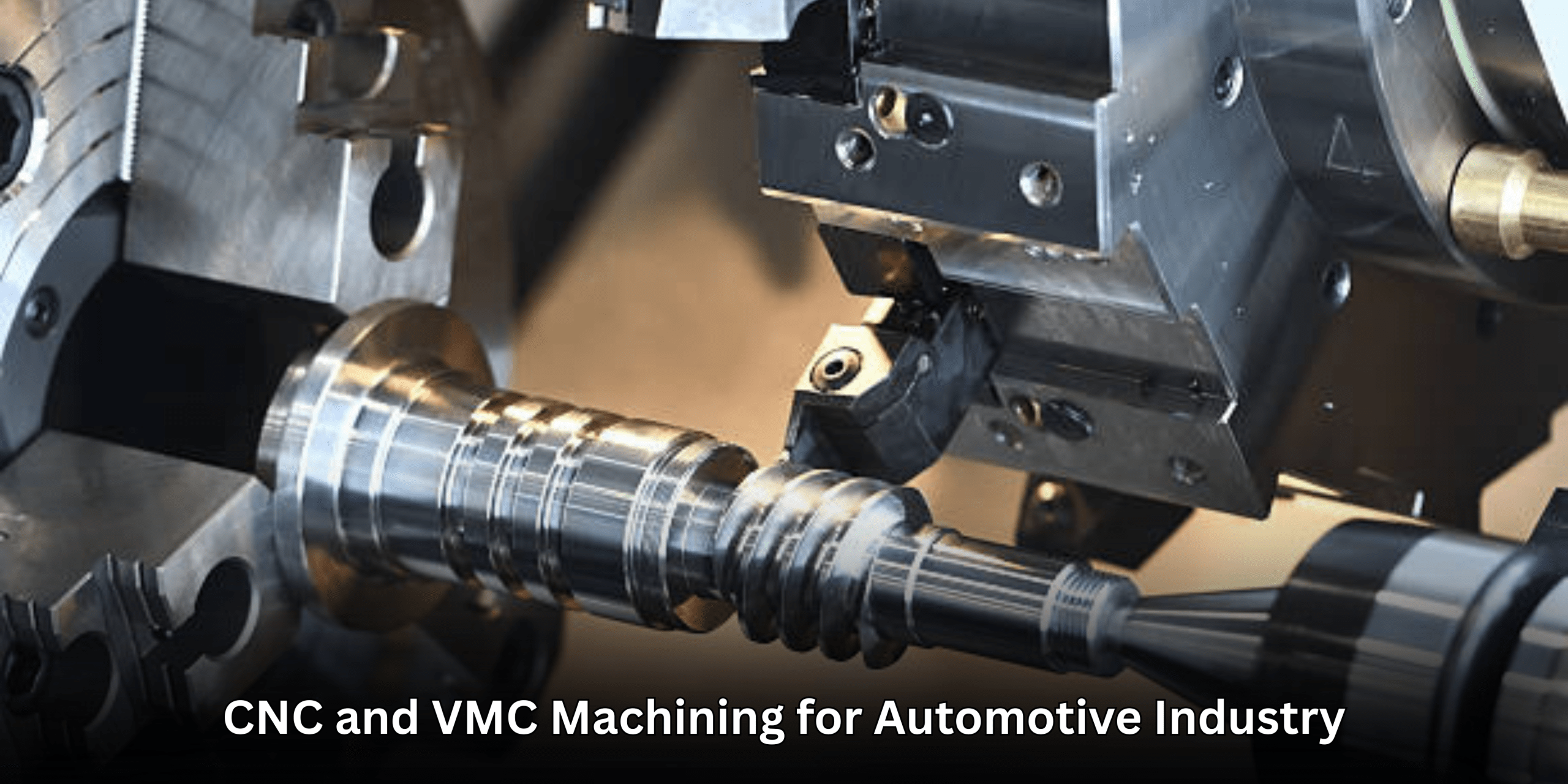
CNC machining includes operations similar as CNC milling and CNC turning.
CNC milling uses rotating cutting tools to remove material from a fixed workpiece. It’s generally used to produce flat shells, places, and detailed shapes in auto parts
CNC turning rotates the workpiece while a slice tool shapes it. It’s substantially used to produce round factors similar as shafts, bushings, and spherical automotive components.
CNC automotive manufacturing is known for delicacy and repetition. Once a program is set, the machine can produce identical auto parts again and again without variation. This makes CNC machining ideal for the automotive industry, where thickness is critical.
Another major benefit is bettered quality control. Since the machine follows programmed instructions, there’s minimum threat of dimensional crimes. This ensures that automotive components meet strict engineering norms.
What’s VMC( Vertical Machining Center)?
VMC Machining refers to machining operations performed on a Vertical Machining Center. In this machine, the spindle is deposited vertically. The slice tool moves up and down while the workpiece is fixed on a table.
The automotive industry relies on VMC Machining because of its ability to provide high precision and stability. The system achieves its best performance when making flat shells and drilled holes and advanced shapes for automotive parts.
One major advantage of VMC Machining is effectiveness. It can perform multiple operations in a single setup. This reduces handling time and increases productivity.
Numerous CNC automotive manufacturers use VMC systems for producing machine blocks, gearbox jackets, boscage factors, and structural auto parts. The perpendicular setup allows better chip junking and bettered face finish.
Like CNC machining, VMC Machining also supports strong quality control. Detectors and covering systems insure every part meets needed specifications.
In simple terms, VMC Machining is a important and dependable result for perfection engineering in the automotive industry.
Why Precision Machining is Critical in the Automotive Industry
Precision is extremely important in the automotive industry. Vehicles operate under demanding conditions. Small dimension crimes can lead to serious problems.
Every automotive part must meet strict forbearance limits. Forbearance refers to the allowed variation in confines. In numerous cases, forbearance are measured in microns.
CNC machining ensures high delicacy in both CNC milling and CNC turning processes. This helps manufacturers produce auto parts that fit together impeccably.
For illustration, machine factors bear exact alignment.However, the machine may heat or fail, If confines are slightly out. Precision engineering prevents similar issues.
VMC Machining improves dimensional stability during product. Its perpendicular structure reduces vibration and enhances cutting delicacy.
Precision machining also improves safety. Brake systems, suspense factors, and transmission components must perform reliably. Accurate automotive components reduce the threat of mechanical failure.
Another important factor is quality control. The automotive industry follows strict norms. CNC automotive product includes examination processes that corroborate each element.
In short, perfection machining is essential because it ensures performance, continuity, and safety in the automotive industry.
Significance of CNC & VMC in Automotive Component Production
CNC machining and VMC Machining play a central part in producing automotive industry.They enhance effectiveness, thickness, and overall engineering quality.
Let us look at their significance in detail.
1.High Precision and Tight Forbearance
Ultramodern vehicles bear extremely precise factors. Tight forbearance insure smooth operation and longer lifetime.
CNC machining delivers accurate results because it follows computer- controlled instructions. CNC milling creates detailed shells, while CNC turning produces accurate spherical shapes.
VMC Machining enhances perfection through stable perpendicular slice. This reduces dimensional variation.
In the automotive industry, indeed minor crimes can affect performance. High perfection automotive components insure smooth assembly and better functionality.
Strong quality control systems corroborate that each element meets engineering norms.
2. Mass product with thickness
The automotive industry produces millions of vehicles every time. Each vehicle contains thousands of auto parts.
CNC automotive systems make large- scale product possible. Once programmed, CNC machining can produce identical parts constantly.
VMC Machining supports batch product by performing multiple operations without displacing the workpiece.
thickness is critical for maintaining brand character. guests anticipate dependable vehicles.Livery automotive components insure predictable performance.
3. Reduced mortal Error
Homemade machining frequently involves mortal judgment, which can lead to miscalculations.
CNC machining reduces dependence on homemade operation. The computer controls tool movement and cutting speed.
CNC milling and CNC turning processes are automated. This minimizes crimes and improves quality control.
VMC Machining systems include detectors that cover slice conditions.These systems help to describe problems beforehand.
Reducing mortal error improves productivity and lowers manufacturing costs in the automotive industry.
4. Faster product Cycles
Speed is important in competitive requests. Manufacturers must meet demand without compromising quality.
CNC automotive product allows nonstop operation. Machines can run for long hours with minimum supervision.
VMC Machining supports automatic tool changes. This reduces time-out between operations.
Faster product cycles help companies deliver automotive components on time.
Effective engineering processes increase overall profitability.
Operation of CNC Machining
CNC machining has a wide range of operations in the automotive industry.
It’s used to manufacture machine factors similar as cylinder heads and blocks. These components bear precise CNC milling for accurate shells.
CNC turning is generally used to produce shafts, bushings, and transmission factors.
CNC automotive systems also produce boscage factors, steering parts, and suspense rudiments.
Prototype development is another crucial operation. masterminds use CNC machining to test new designs before mass product.
CNC machining also supports customization. Manufacturers can modify designs snappily using digital programming.
Strong quality control ensures each part meets safety norms.
Overall, CNC machining supports nearly every major system in ultramodern vehicles.
Operation of VMC Machining
VMC Machining is extensively applied in producing flat and complex automotive components.
It’s used for machining gearbox jackets and structural factors.
VMC Machining is ideal for drilling and tapping operations in machine blocks.
Numerous automotive components bear multi-face machining. VMC systems handle these tasks efficiently.
The automotive industry also uses VMC Machining for aluminum factors because it offers excellent face finish.
High- speed slice improves productivity while maintaining quality control.
Because of its versatility, VMC Machining remains essential in ultramodern engineering surroundings.
Conclusion
CNC machining and VMC Machining are the backbone of ultramodern automotive manufacturing.
The automotive industry depends on precise and dependable automotive components. These technologies insure delicacy, effectiveness, and thickness.
CNC milling and CNC turning processes produce high- quality auto components with tight forbearance.
CNC automotive systems reduce mortal error and ameliorate product speed.
VMC Machining enhances stability and supports large- scale manufacturing.
Strong engineering practices and effective quality control guarantee safe and durable vehicles.
As the automotive industry continues to evolve, CNC machining and VMC Machining will remain essential technologies.
In simple words, these advanced systems make it possible to produce dependable automotive parts that meet ultra modern performance and safety norms.