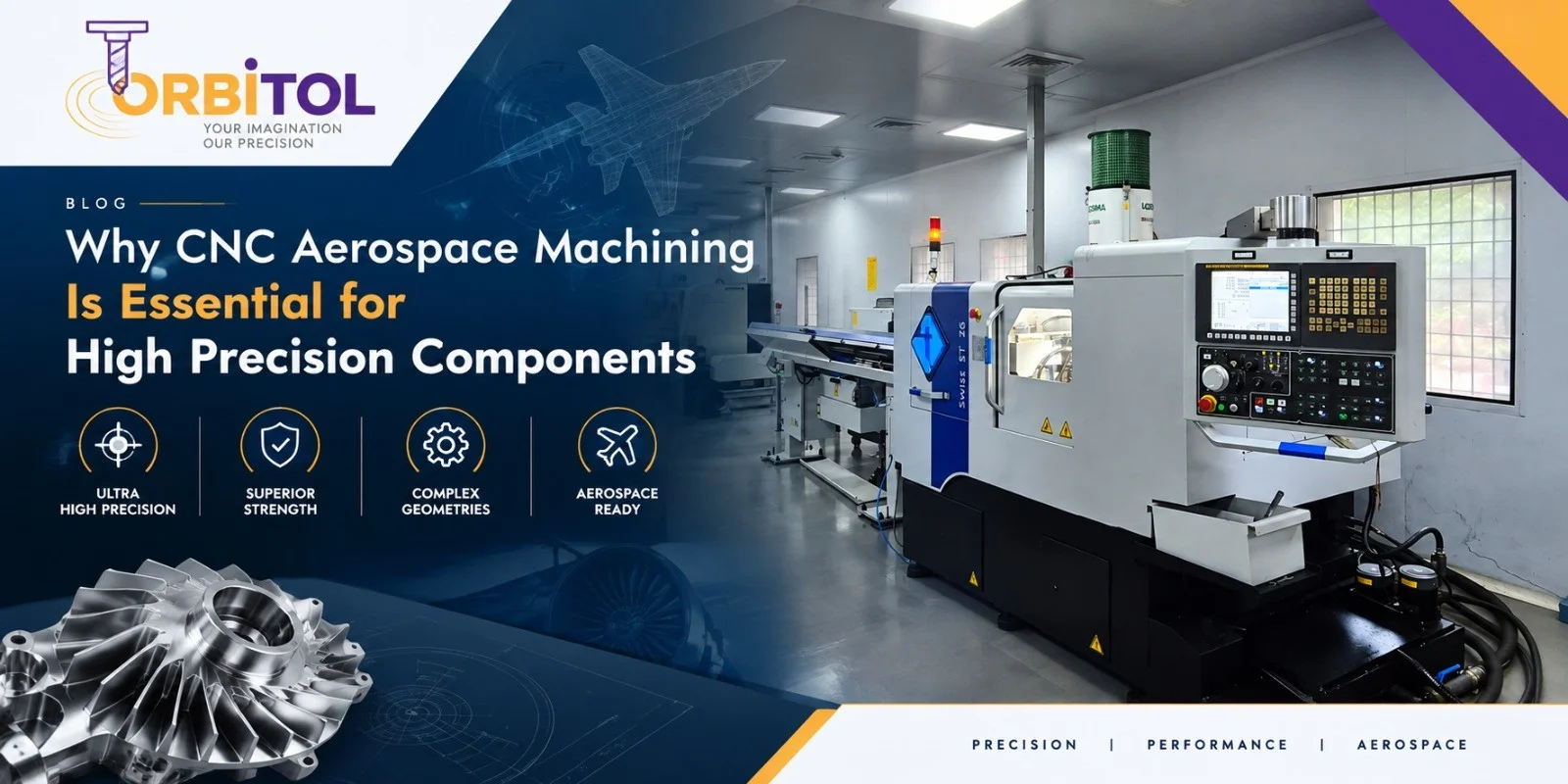
Accuracy is not something that can be chosen in those kinds of industries where an error of a single micron can cause a disaster. The mentioned reality is even more valid for the aerospace engineering and the defense sectors, which are the places where the components are working under the extreme conditions such as the high pressure, the high temperature, shaking, and the continuous mechanical stress.
From the engines of the aircraft and the structures to the missile systems and the fasteners of the defence-grade, each and every one has to pass the strictest tests. In such a case, CNC machining is the one that cannot be replaced. The present day aerospace and defence production are almost completely dependent on CNC-driven precision engineering to obtain the highest level of repeatability, reliability, and safety.
Here at the blog, we discuss the reasons why CNC machining is a must to achieve the high precision of aerospace and defence components, how it can be used to advance the aerospace engineering, and why manufacturers all over the world trust CNC technology to meet the most demanding industry standards.
The Accuracy Demands of Aerospace Engineering and Defence Manufacturing
Aerospace and defence components are different from industrial ones in a very significant manner: they are not allowed to fail. These parts have to work under the environmental conditions such as:
- Extreme temperatures
- High-speed rotation
- Heavy vibration and load
- Corrosive atmospheres
- Continuous operational cycles
In an aircraft design, a very small change in the dimension can have an impact on the aerodynamics, the use of the fuel, or the strength of the structure.
Moreover, precision in the defense field is directly related to the performance, the safety, and the accomplishment of the mission. The precision of this magnitude cannot be obtained only by using traditional machining methods. It takes advanced CNC machining systems that are able to keep very short tolerances over complicated geometries.
What Makes CNC Machining Essential for Aerospace and Defence?
CNC machining (Computer Numerical Control machining) automates the production by the help of precision software programs that control the machines performing the tasks. In contrast with manual or semi-automatic methods, CNC machining results in:
- Consistent dimensional accuracy
- High repeatability for batch production
- Capability to machine complex shapes
- Reduced human error
- Superior surface finish
For aerospace and defence manufacturers, CNC machining is not just a production method it is the foundation of precision engineering.
Precision Engineering: The Backbone of Aerospace and Defence Components
Precision engineering is an area that emphasizes the creation of the product with the closest possible tolerance and the smallest variation of the dimension. This comes about through CNC Machining which strategically combines the following:
- Innovative software programming
- Machine components with high resistance to deformation
- Accurate tool control
- Several-axis machining capabilities
Manufacturers are now able to fabricate complicated aerospace parts that are in line with the strict regulatory and performance standards, thanks to this combination.
Key Aerospace and Defence Components Manufactured Using CNC Machining
1. Aerospace Structural Components
Aerospace structures have to be both light and strong. The process of CNC machining is very accurate in removing material to achieve the best strength-to-weight ratio. Some of the common CNC-machined aerospace components are:
- Brackets and mounts
- Frames and housings
- Structural supports
It is these parts that have to be perfect in shape and size in order to be joined efficiently, aerodynamic stability and structural soundness are thus guaranteed.
2. Aerospace Fasteners
On the other hand, aerospace fasteners are small powerhouses that bring together the pieces of the aircraft and, in so doing, are essential for the whole structure to be safe. The fasteners should be able to resist:
- Heavy tensile loads
- Uninterrupted vibration
- Extremely fluctuating temperatures
With the help of CNC machining, aerospace fasteners are able to achieve precise thread profiles with high dimensional accuracy as well as the required surface finish. This level of consistency is something that is very difficult to achieve through manual operations.
3. Engine and Turbine Components
Aerospace engines are the types that operate at very high speeds and temperatures. CNC machining is the manufacturing method for the following:
- Precision housings
- Engine mounts
- Rotating components
Imbalance on a microscopic scale or misalignment in the aerospace engineering field is what results in less engine efficiency and sometimes engine failure. CNC machining is the one that provides the precision necessary to eliminate these chances.
4. Defence Equipment Components
The defence industry cannot do without CNC machining that is used in the production of parts employed in:
- Military vehicles
- Weapon systems
- Surveillance and communication equipment
- Defence-grade mechanical assemblies
The components are the ones that have to be made according to exact dimensions if they are to work efficiently even when the environment is tough and unpredictable.
Why Traditional Manufacturing Falls Short
Traditional manufacturing methods greatly depend on the manual operations of workers, thus introducing variability. On the other hand, CNC machining has the following advantages:
Automated control for consistency Digital precision through programmed tool paths Better control over tolerances Faster production with fewer defects When it comes to aerospace and defense applications, it is just not possible for the traditional methods to be up to the task of delivering the reliability and accuracy required by modern standards.
Tight Tolerances and Repeatability: A CNC Advantage Perhaps the greatest asemblage of CNC is its capacity to uphold a narrow span of allowance over a bunch of production runs. An example from the aerospace field, tolerances are in many cases referred to as being of the micron scale.
With CNC machining, it is guaranteed that:
- Quality of the product will be as per the given specification
- One batch of production will be as good as the other
- The compatibility of the parts in the assembly will be the same
The repeatability feature is the main one that is a must not only for the aerospace manufacturing industry but also for the defence industry.
Material Versatility for Aerospace and Defence Applications
The first thing that comes to the mind, of course, is the revolutionary application of aluminum alloys, the titanium, and the stainless steel have been the main metals used in the last decade. Besides these, high-strength superalloys also find their place within the aerospace and defence materials family. What CNC machining does is to allow these materials to be cut and shaped in a highly precise manner without compromising their inherent strength. The flexibility provided is of uttermost importance to aerospace engineering that seeks high performing and durable materials.
Multi-Axis CNC Machining for Complex Geometries
The geometries found on the modern-day aerospace parts have reached a level of complexity that a simple machining operation is not capable of producing them. Multi-axis CNC machining can:
- The items can be machined from any angle
- less time is spent on setting up
- The accuracy is increased
- Surface finishing is better than before
Such a capability is justified by the discussion of the case of complex aerospace components and defence parts where intricate designs and tight tolerances are the requirements.
Quality Assurance and Compliance in Aerospace and Defence
The aerospace and defence industries are subject to strict regulations and compliance is a must. CNC machining helps compliance through:
- Consistency in the process
- Traceability
- Quality that can be repeated
Manufacturers using precision engineering supported by CNC machining are in a position to fulfill strict quality requirements and customer expectations.
The Role of CNC Machining in Future Aerospace Engineering
The trend of the evolvement of aerospace engineering is that the components are turning out to be:
- Lighter
- Stronger
- More complex
They will be able to realize this fact of the matter only by continuing to rely on CNC machining which is
- Paving the way for futuristic component design
- Allowing performance to be improved
- Manufacturing errors to be reduced
- Production cycles to be accelerated
CNC machining will always be very important in the defence sector as the requirements for more advanced systems and increased precision will be met.
Why Precision-Driven Manufacturers Lead in Aerospace and Defence
By introducing progressive CNC machining technology and perfecting your engineering potential, your manufacturing will rise above the rest and you will be capable of performing in the aerospace and defence sector at the highest level. The three cornerstones of your ability -accuracy, reliability, and consistency- will turn you into the dream partner for mission-critical components.
Investing in precision machining infrastructure, hiring top-notch engineers, and establishing quality systems are the keys that will open the door to the future of aerospace component manufacturing for companies.
Conclusion
A work of high precision is a prerequisite for triumph in the case of aerospace engineering and the defence scene. CNC machining is that enabling technology that permits manufacturers to reach the level of precision, repeatability, and reliability necessary for mission-critical components.
To mention just a few, aerospace fasteners, complex structural assemblies, are the parts of the whole aerospace and defence manufacturing that are supported by CNC machining.
If you are a manufacturer willing to provide world-class aerospace components and defence-grade parts, then investing in CNC machining is not a matter of options but rather a must-have.